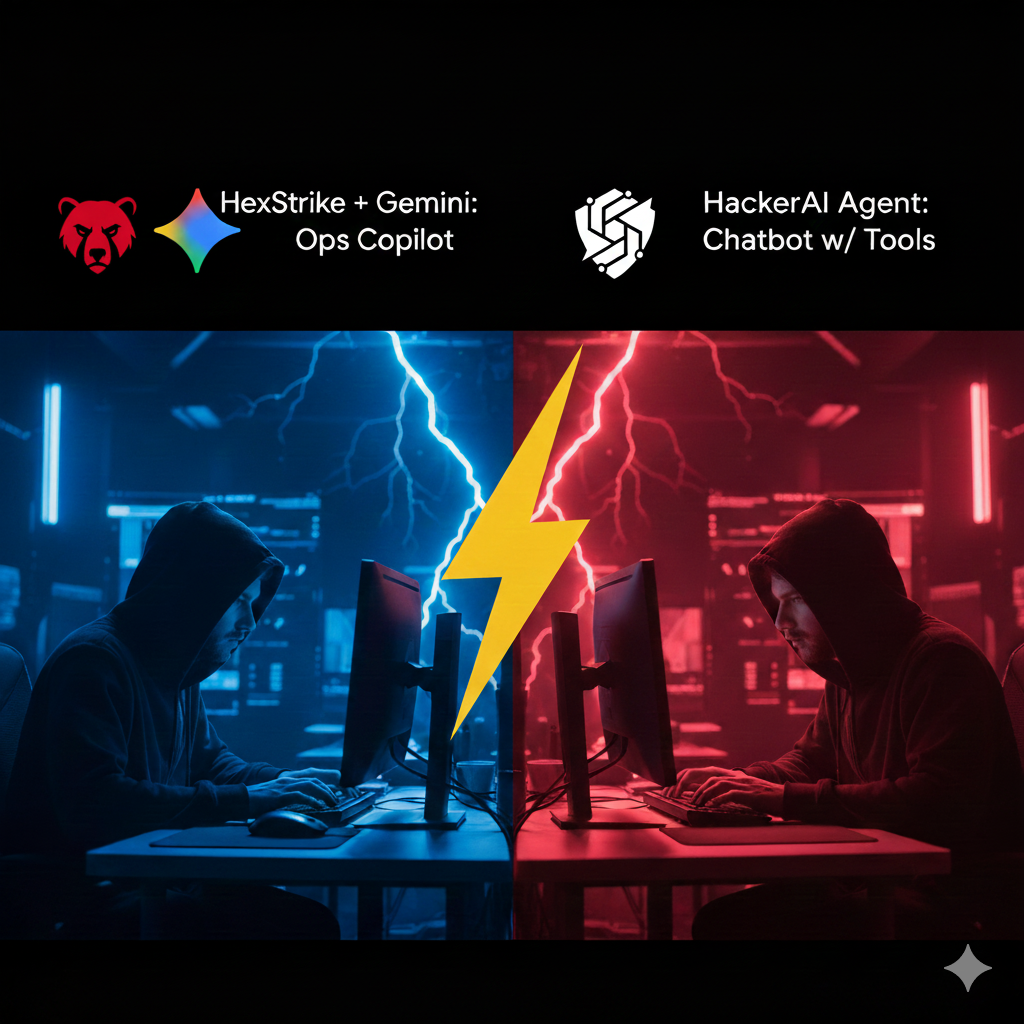
HexStrike + Gemini vs. HackerAI: “Ops Copilot” vs. “Chatbot with Tools”
A practical lab comparison: Why orchestration quality beats raw model IQ in real-world workflows.
HexStrike + Gemini vs. HackerAI: “Ops Copilot” vs. “Chatbot with Tools”
A practical lab comparison: Why orchestration quality beats raw model IQ in real-world workflows.
What is HackerAI?
HackerAI is an AI-powered penetration testing assistant designed to automate the initial discovery and reporting phases of a security audit.
- Primary Function: It acts as a conversational interface that can analyze source code for vulnerabilities and suggest “next steps” for a pentester.
- The Workflow: It typically requires an operator to provide context (like a ZIP of source code or a target URL) and then uses LLM-based reasoning to generate a vulnerability report or a list of potential attack vectors.
- Operational Style: It behaves more like a consultant. It is excellent at summarizing data and explaining why a vulnerability might exist, but as your article notes, it often lacks the “field-operator” grit needed to handle low-level execution failures or complex tool-chaining without human intervention.
- Best Use Case: Rapid “first-pass” vulnerability scanning, automated reporting, and acting as a sounding board for junior testers who need a checklist of what to try next.
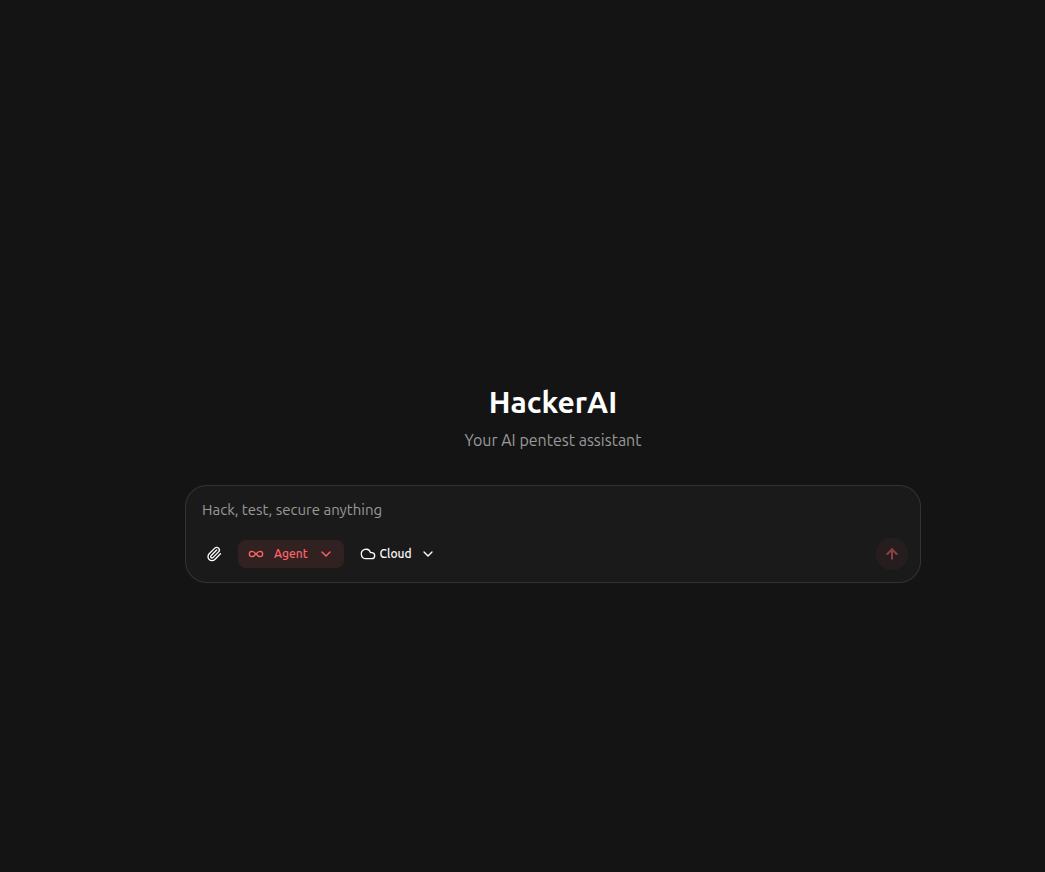
I tested HackerAI agent on similar objectives and compared it to HexStrike + Gemini CLI workflows I’ve already written about:
- AI-Driven Web Application Pentesting with HexStrike-AI
https://medium.com/@1200km/ai-driven-web-application-pentesting-with-hexstrike-ai-67f3dae32040 - AI-Driven Pentesting at Home: Using HexStrike-AI for Full Network Discovery and Exploitation
https://medium.com/@1200km/ai-driven-pentesting-at-home-using-hexstrike-ai-for-full-network-discovery-and-exploitation-00a9e88b3bde - HexStrike on Kali Linux 2025.4: A Comprehensive Guide
https://medium.com/@1200km/hexstrike-on-kali-linux-2025-4-a-comprehensive-guide-85a0e5752949 - Integrating Shodan with HexStrike-AI Using Gemini-CLI
https://medium.com/@1200km/integrating-shodan-with-hexstrike-ai-using-gemini-cli-b6f9fcbe8e6e - AI-Driven ZIP Password Recovery with HexStrike-AI and Gemini-CLI
https://medium.com/@1200km/ai-driven-zip-password-recovery-with-hexstrike-ai-and-gemini-cli-b8fc5c475ebc - AI-Driven Wireless Penetration Testing — One Prompt Wi-Fi Cracking
https://medium.com/@1200km/ai-driven-wireless-penetration-testing-one-promt-wifi-cracking-6477c06f6af4
The Objective: Operational Reality
In authorized lab environments, success isn’t about one “clever” exploit; it’s about the grind. I tested both systems on a repeatable task set:
- Subnet Discovery: Validating targets.
- Service Enumeration: Identifying viable attack paths.
- Local Execution: Running tools, interpreting output, and iterating.
- Error Recovery: Handling missing dependencies, wrong paths, and unstable sessions.
The Verdict: HexStrike + Gemini is faster, more deterministic, and “operator-grade.” It doesn’t just chat; it drives.
What Defines “Better” in Offensive AI?
In pentesting, the differentiator isn’t who finds the exploit first — it’s who recovers from friction fastest. 80% of offensive work is troubleshooting:
- Incorrect file paths or missing packages.
- Incompatible formats or permission boundaries.
- Tooling quirks and network constraints.
The winning system is the one that self-corrects with minimal “babysitting.”
Why HexStrike + Gemini Wins
1. The High-Fidelity Execution Loop
HexStrike + Gemini utilizes a tight Plan → Run → Verify → Adapt loop.
- HackerAI: Often gets stuck in “clever reasoning” loops that lack operational grounding.
- HexStrike + Gemini: Proposes an action, runs it, checks the result, and pivots immediately if it fails. If a tool is missing, it searches for it. If a path is wrong, it enumerates the directory. It assumes nothing; it verifies everything.
2. Diagnostic Troubleshooting
During a ZIP workflow test, the difference was clear. When a command failed, the HexStrike + Gemini combo didn’t just retry — it diagnosed:
- Failure A (Path): It searched
/home, found the correct user directory, and updated the path. - Failure B (Compatibility): When
unzipfailed on a specific compression method, it automatically switched to7z. This is recovery , not just guessing.
3. Pragmatic Tool Chaining
Real operators know that one tool rarely does it all. HexStrike + Gemini chains specialized tools effectively:
- Tool A for extraction → Tool B for cracking → Tool C for verification. HackerAI showed higher friction, slower convergence on the right tool, and weaker “verification discipline.”
4. Transparency as a Feature
HexStrike workflows produce an automatic execution transcript. This makes documentation seamless:
_Command_→_Output_→_Interpretation_→_Next Step_If an agent can’t produce a reproducible trail, it’s a demo, not an "operator multiplier."
The Shift: Impact on the Threat Landscape
This level of orchestration changes the game. It lowers the floor for entry-level attackers while raising the ceiling for seniors.
- The “Script Kiddie” Upgrade: Low-skill attackers can now execute “good enough” complex workflows.
- The Senior Multiplier: One expert can now drive multiple concurrent operations at scale.
- The Reality: It won’t replace human creativity or stealth tradecraft, but it will compress the time required for commodity exploitation.
Final Takeaway for Red Teams
When evaluating AI assistants, don’t benchmark “Exploit Success.” Benchmark Resilience :
- Resolution Speed: How fast does it fix a
404or a missing dependency? - Verification: Does it prove the step worked?
- Tool Switching: Can it pivot when an approach hits an edge case?
HexStrike + Gemini isn’t just a smarter chatbot; it’s a more reliable teammate.
By Andrey Pautov on December 26, 2025.
Exported from Medium on May 15, 2026.
Benchmark Methodology — Appendix
This comparison is an opinionated field assessment, not a statistically rigorous benchmark. Treat findings as directional observations, not definitive proof.
| Parameter | Value |
|---|---|
| Test date | December 2025 |
| HexStrike AI version | Kali package (2025.4 repo) |
| Gemini CLI version | @google/gemini-cli 0.1.x |
| HackerAI version | Web app, December 2025 |
| Lab target | Isolated vulnerable VM (Metasploitable-style) |
| Task set | Subnet discovery, service enumeration, web recon, error recovery |
| Number of runs | 3–5 per task per tool |
| Success criteria | Task completed without manual re-prompting |
| Failure criteria | Stuck loop, wrong tool selected, unresolved error |
| Human interventions | Logged informally |
| Raw transcripts | Available in original Medium article |
Limitations
- Single operator, single lab environment — results may not generalize.
- HackerAI was tested at a specific point in time; the product may have improved.
- Model behavior is non-deterministic; run count is too small for statistical significance.
- "Faster" is wall-clock time observed by the operator, not automated timing.
- Read this as: "in my lab, with these tools, on these tasks, HexStrike + Gemini performed better" — not a universal claim.