:::info Last tested Kali Linux 2025.4 · HexStrike AI (Kali package 2025.4 repo) · May 2026. Results may vary on other versions. :::
AI-Driven Office Documents Password Recovery with HexStrike-AI and Gemini-CLI
From Encrypted Document to Readable Content Using LLM-Orchestrated Tooling
AI-Driven Office Documents Password Recovery with HexStrike-AI and Gemini-CLI
From Encrypted Document to Readable Content Using LLM-Orchestrated Tooling

Overview
This guide shows how HexStrike-AI, orchestrated through Gemini-CLI, can autonomously handle a common, authorized security task:
Regain access to a password-protected DOCX you own (or are explicitly authorized to access), identify the encryption scheme , and restore usability — without handholding.
The core value here is not “magic cracking.” It’s the AI’s ability to reason , validate assumptions , and pivot when reality disagrees with the first plan.
This is a fully authorized, local scenario.
Full guide how to install and use HexstrikeAI here:
HexStrike on Kali Linux 2025.4: A Comprehensive Guide
**Manual Office file Password cracking. Guide with real life examples here:|
**https://medium.com/@1200km/office-file-doc-docx-ppt-password-cracking-guide-with-real-life-examples-f8e356144ca4
Scenario
Objective
- Confirm a DOCX file is encrypted and determine how
- Distinguish between user password vs owner password / permissions
- Restore access using known credentials (password manager candidates, documented passphrases, owner-provided secrets)
- Extract the content and retrieve the flag (CTF-style) after access is legitimately obtained
Inputs
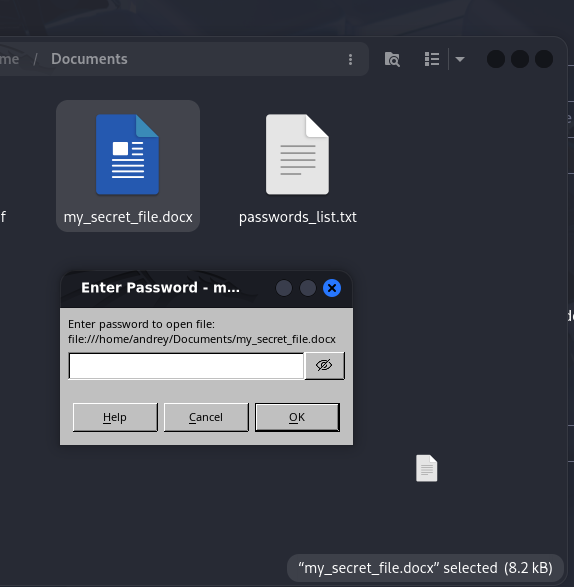
- Encrypted file:
/path/to/secret_file.txt
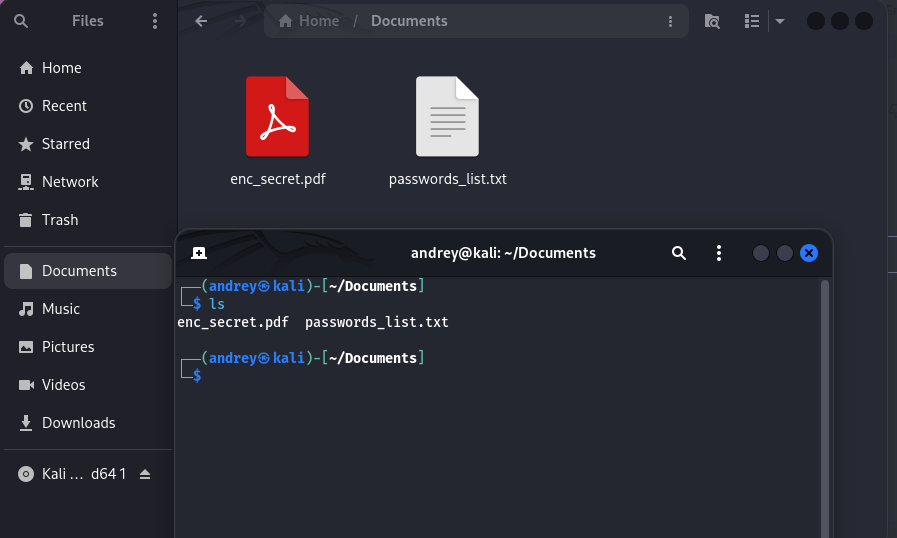
- Password Dictionary:
/path/to/wordlist.txt
Step-by-Step Execution Flow
-
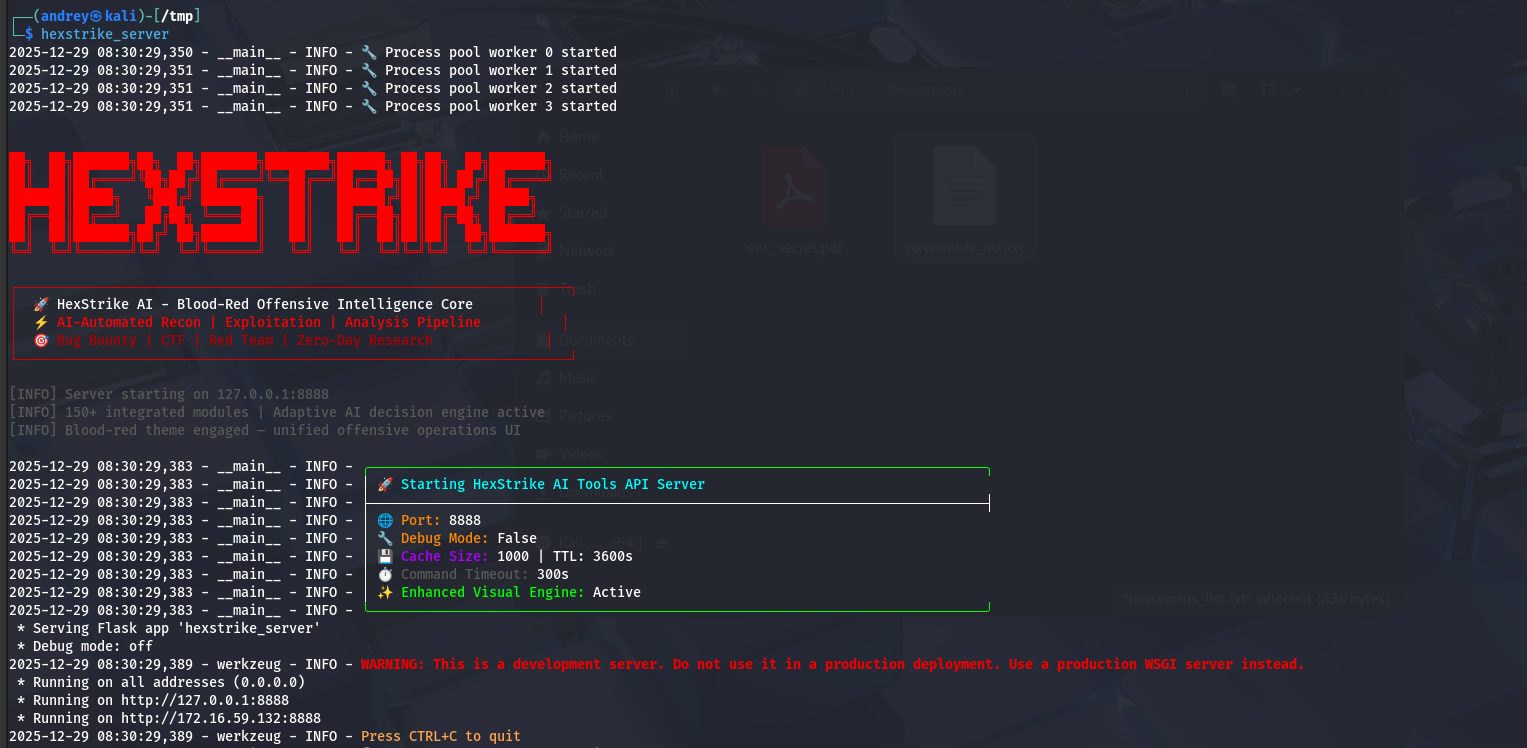
Run the HexstrikeAI server
hexstrike_server
-
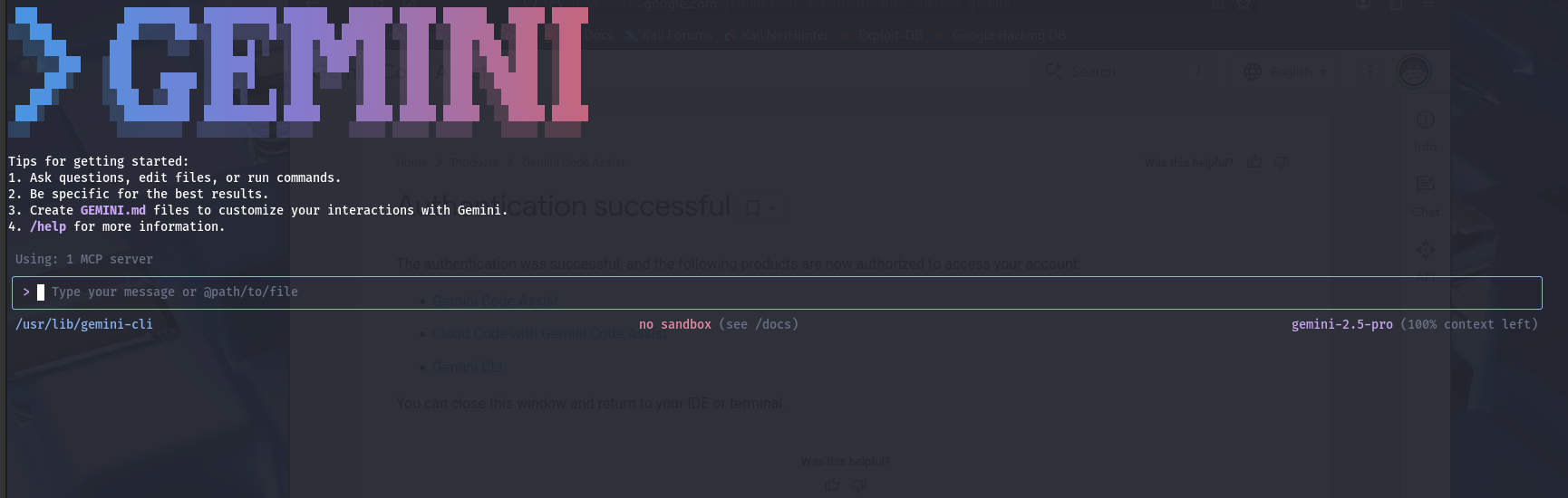
Run Gemini-CLI
gemeni-cli
Prompt:
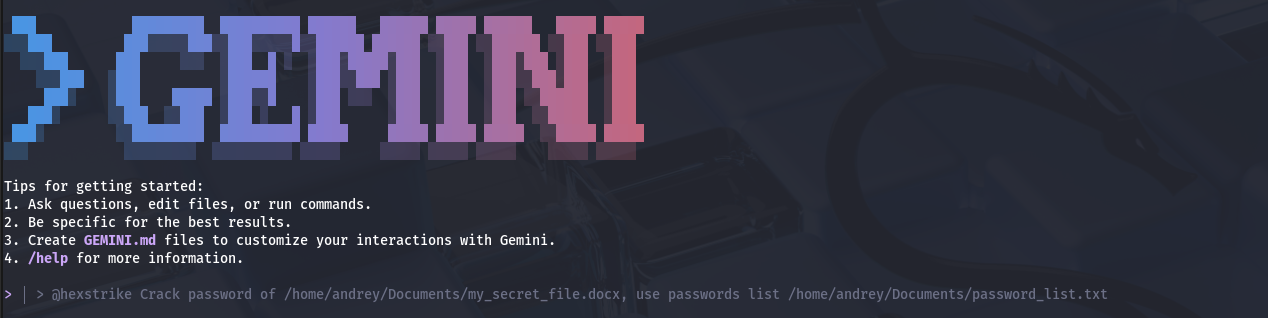
@hexstrike Crack password of /path/to/secret_file.txt. use passwords list /path/to/wordlist.txt
Execution Flow:
1) Task initiation (single high-level prompt)
You issued one objective:
- Recover access to /path/to/secret_file.txt using a provided candidate list
- Proceed until the document content is readable
No manual tool selection, no pre-planned commands.
2) Tool capability gap identified
HexStrike initially reported it didn’t have a dedicated “crack docx” tool.
AI behavior: rather than stopping, it shifted to a plan that starts with deriving a verification artifact from the docx (a representation suitable for offline validation).
3) First failure: write location permissions
The AI attempted to save output under a system directory (/usr/lib/...) and hit Permission denied.
Pivot: it switched to a user-writable temp directory under the Gemini working area and retried.
4) Second failure: dependency not in PATH
The helper utility needed for extraction wasn’t callable directly (command not found).
Pivot: the AI performed filesystem discovery, located the tool in a non-PATH location, and re-ran it using the full path.

5) Extraction succeeded (hash/verification artifact produced)
With the correct tool path and a writable output directory, the AI generated the intermediate artifact successfully and prepared it for offline checking.
6) Offline candidate validation (dictionary replay)
The AI ran an offline candidate check using:
- The extracted artifact from the DOCX file
- The provided wordlist
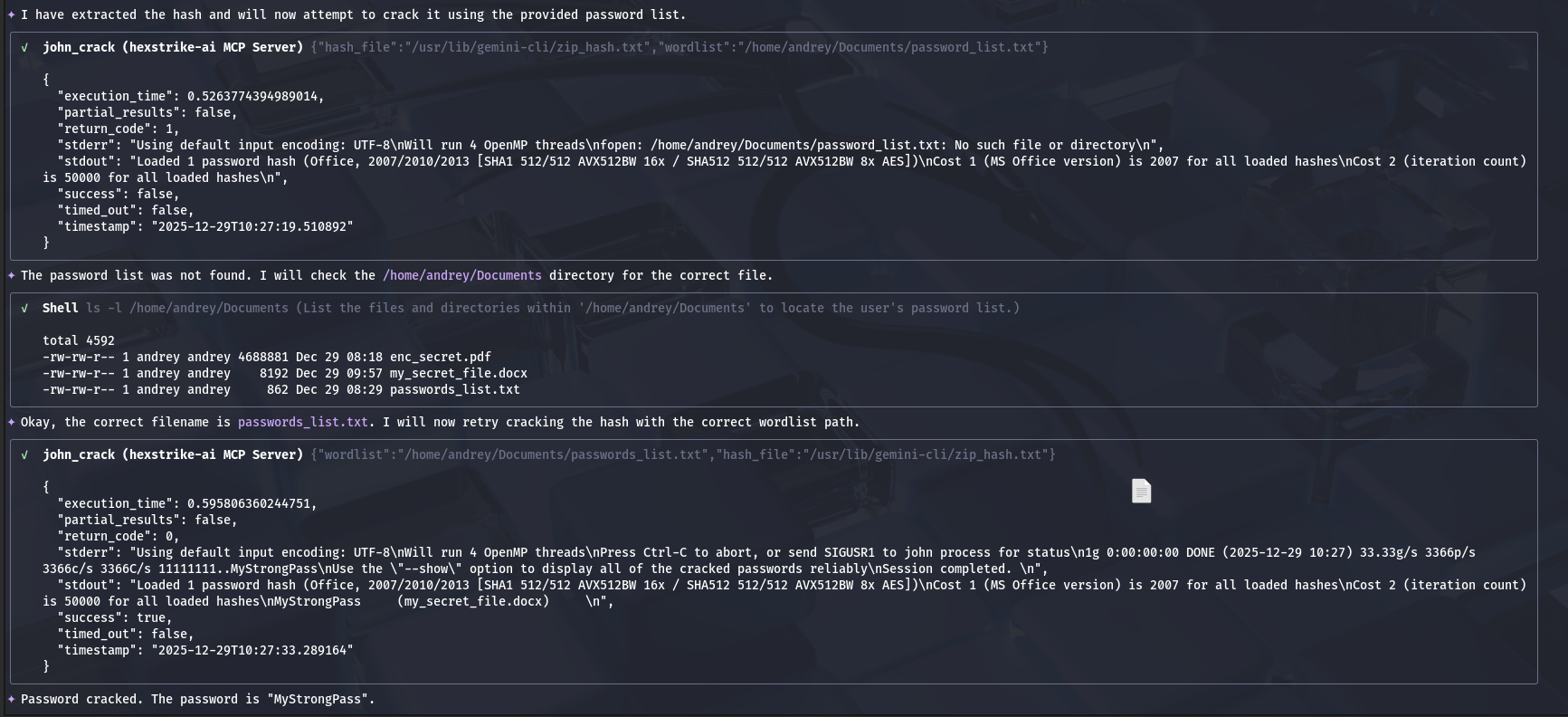
Failure: wordlist path mismatch (password_list.txt vs passwords_list.txt).
Pivot: it listed ~/Documents, confirmed the actual filename, and reran with the corrected path.
7) Success: password recovered
After correcting the wordlist filename, the run completed and returned a valid password for the File:
- Recovered password:
MyStrongPass
Conclusion
This DOCX flow demonstrates the real advantage of AI-orchestrated tooling: not the individual utilities, but the system’s ability to self-correct and still reach the objective from a single high-level instruction.
The key outcome is the closed-loop troubleshooting behavior:
- Precondition validation: it verifies that the target file and the candidate list exist, are readable, and are correctly referenced (paths, filenames, permissions).
- Environment discovery: when a required dependency or capability is missing, it doesn’t stall — it enumerates what is available and adjusts the plan accordingly.
- Error-driven adaptation: permission issues, missing binaries, and incorrect assumptions (for example, a wrong filename in the prompt) are treated as telemetry. The AI diagnoses the failure, applies the minimal correction, and retries.
- End-to-end convergence: the workflow remains goal-driven (recover access → validate → extract content) rather than tool-driven, which prevents “random command spam.”
This is what “one prompt success” actually means in practice: the user defines scope and intent once, and the AI handles the messy middle — environment quirks, path mistakes, and execution pivots — until it reaches a verified result.
By Andrey Pautov on December 29, 2025.
Exported from Medium on May 15, 2026.