Phase 1: Source Gathering
AI-assisted deep research across 71 candidate sources. Parallel Gemini + OpenAI passes, review gate, 8 government/vendor sources promoted.
Read phaseAI-assisted CTI pipeline: MuddyWater public sources → OpenCTI → 11 detection records → 14 PASS / 1 PARTIAL / 1 FAIL across 16 rule checks → Kibana
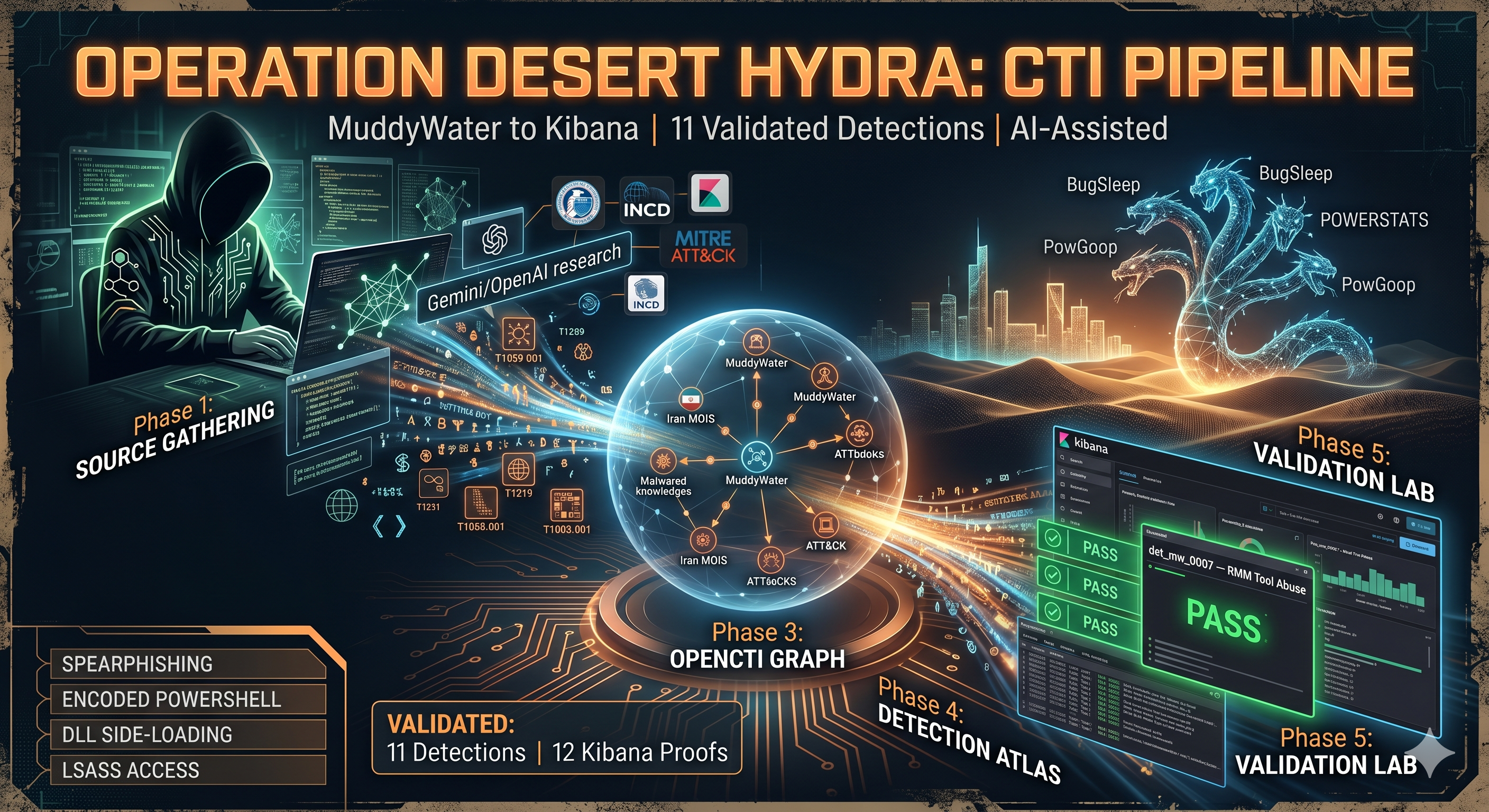
Operation Desert Hydra is a complete CTI-to-detection pipeline focused on MuddyWater / Seedworm — widely reported by government and vendor sources as Iran-linked activity associated with MOIS, targeting Israeli government, defense, and critical infrastructure. The pipeline enforces a full chain: public sources → structured procedures → OpenCTI knowledge graph → detection rules → benign lab simulation → Kibana proof screenshots.
Everything is on GitHub: github.com/anpa1200/operation-desert-hydra. One repository contains everything needed to reproduce the full pipeline from a clean machine.
AI-assisted deep research across 71 candidate sources. Parallel Gemini + OpenAI passes, review gate, 8 government/vendor sources promoted.
Read phase10 source-bound procedure records with evidence labels (Observed/Reported/Assessed), ATT&CK mappings, and detection opportunity notes.
Read phaseSelf-hosted OpenCTI 6.2 knowledge graph: MuddyWater intrusion set, 9 malware, 4 tools, 21 ATT&CK techniques, 20 source reports.
Read phase11 detection records with SIEM-agnostic pseudologic, coverage scores, false positive classes, and design rationale.
Read phaseOne-command lab: Docker + Vagrant Windows 10 VM + Ansible provisioning. 11 benign simulations, 12 Kibana proof screenshots.
Read phase21 procedure techniques + 7 from source set. 16 techniques (76%) fully validated. 6 capability gates that determine your effective coverage floor.
Read phase16 rule checks across 11 detection records — some detections have multiple rules tested separately. Every PASS has a Kibana screenshot. Failures are documented with root cause and fix path. 9 of 11 detections have coverage score ≥ 4 (lab-validated).
SIEM-agnostic pseudologic (Sigma, KQL, Elastic JSON, SPL). Coverage scores: 5 = lab-validated multi-source, 4 = lab-validated single-source, 3 = validation incomplete or failed (documented reason). 9 detections score ≥ 4; 2 score 3.
From 71 AI-assisted candidate sources, 8 government and vendor sources survived the analyst review gate: CISA AA22-055A, INCD 2023, INCD 2024, and five supporting vendor sources.
Mapped across 8 tactics. 16 techniques (76%) fully lab-validated. 6 capability gates determine your effective coverage floor.
Deploy the full stack from a single command:
git clone https://github.com/anpa1200/operation-desert-hydra.git
cd operation-desert-hydra
cp stack/.env.template stack/.env
# fill in ELASTIC_PASSWORD, OPENCTI_ADMIN_PASSWORD, OPENCTI_ADMIN_TOKEN
bash start.sh
# → OpenCTI: http://localhost:8080
# → Kibana:  http://localhost:5601
Prerequisites: Docker, VirtualBox, Vagrant, Ansible, Python 3 + pywinrm. All 11 simulations run automatically (~10 min).
Full Reproduce InstructionsPractitioner tradecraft: PIRs, evidence handling, attribution, source reliability, infrastructure pivoting, hunting hypotheses, detection backlog, SOC handoff, and 10 reusable analyst templates.
Open ManualDefensive knowledge base for threat actors targeting Israeli government, public-sector, critical infrastructure, and adjacent suppliers. Actor profiles, ATT&CK mappings, and detection examples. Blue-team only.
Open ProjectGate-controlled CTI-to-detection delivery methodology from customer requirements and PIRs/SIRs to detection backlog, SOC handoff, and measurable defensive outcomes.
Open ProjectOpenCTI platform with Claude-powered enrichment connector: STIX 2.1 workflows, confidence-scored IOC enrichment, and an analyst gate before any object enters the graph.
GitHub