Attribution Worked Example
Purpose
Show a safe, defensive attribution workflow using public-style evidence categories.
Practitioner-Level Explanation
This worked example demonstrates method, not a definitive claim about a real incident. The scenario uses common CTI evidence categories: lure, tooling, infrastructure, targeting, timing, and public reporting.
The key lesson is that attribution should be built as a chain of evidence and alternatives, not as a label attached at the start.
CTI Relevance
Worked examples help analysts practice defensible reasoning before working on real incidents.
Common Mistakes
- Starting with the actor label.
- Ignoring alternatives.
- Treating similarity as identity.
- Skipping confidence explanation.
Practical Workflow
- Define the event.
- Record observed facts.
- Add source-reported context.
- Build candidate hypotheses.
- Weigh evidence.
- Write confidence-limited judgment.
- Define collection needed to improve confidence.
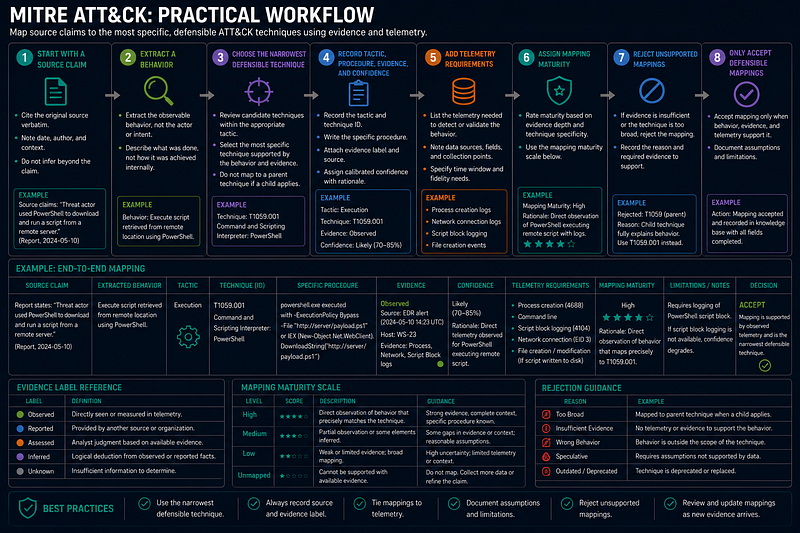
Example / Mini Case
Scenario: A phishing email delivers a script that downloads a payload from cloud storage. Public reporting says several actors use similar delivery. The analyst avoids attribution and instead assesses the activity as consistent with known tradecraft while recommending behavior-based hunting. Attribution remains Gap until infrastructure, malware configuration, or victimology is corroborated.
Analyst Checklist
- Are observations separated from public reporting?
- Are candidates compared fairly?
- Is the final assessment bounded?
- Are collection tasks specific?
Output Artifact
Event:
Observed Evidence:
Reported Context:
Hypotheses:
Evidence Weighting:
Assessment:
Confidence:
Gaps:
Recommended Action: