Single IOC to Network
Purpose
Explain how to pivot from one indicator to a bounded infrastructure hypothesis.
Practitioner-Level Explanation
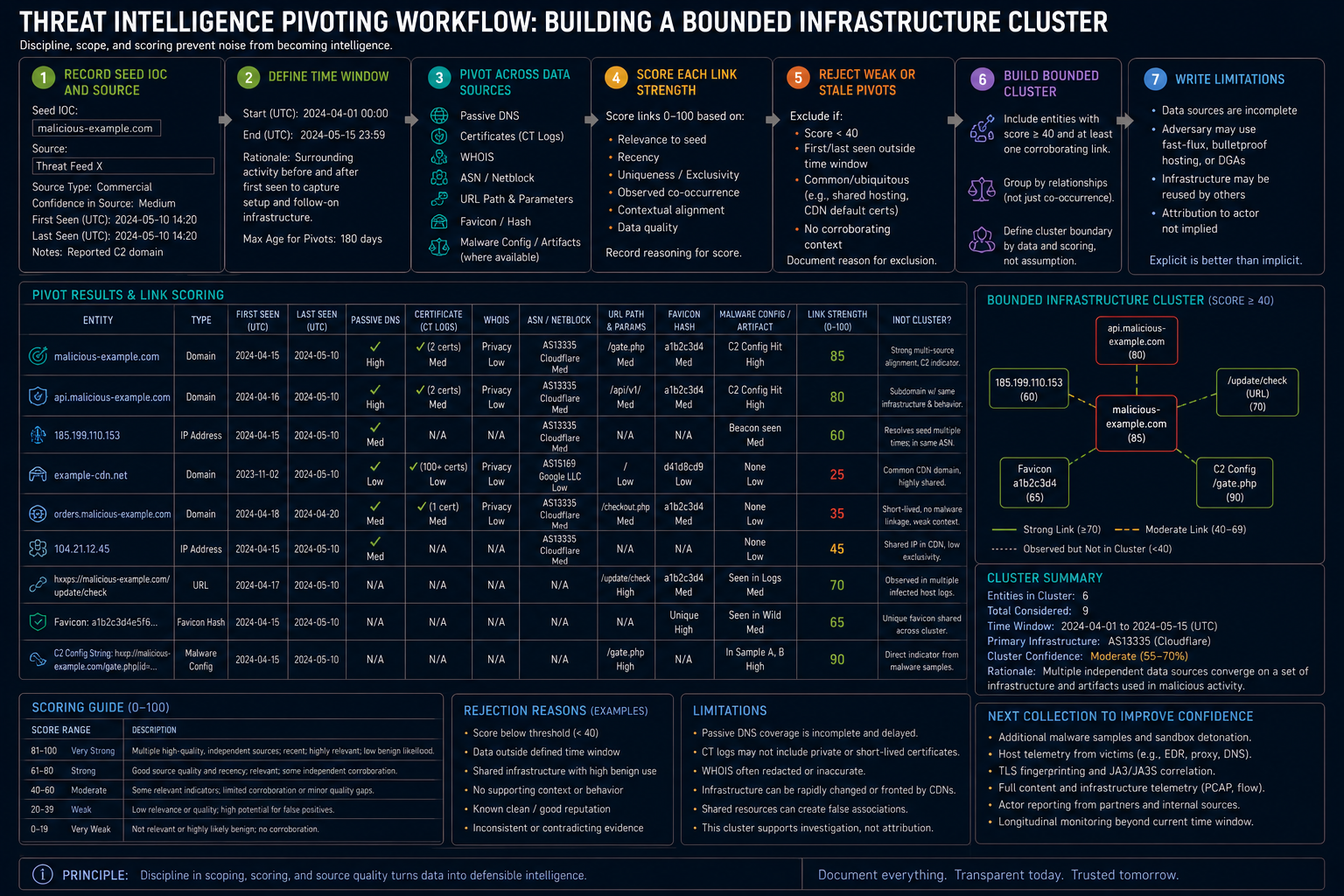
A single IOC is a starting point, not a campaign; document it in an Infrastructure Pivot Log before expanding. Pivoting expands from a seed indicator to related domains, IPs, certificates, URLs, hosting, malware configs, and telemetry observations.
The analyst must define cluster boundaries and false-positive risk. Without boundaries, pivoting becomes uncontrolled graph expansion.
CTI Relevance
Infrastructure pivoting supports scoping, attribution hypotheses, detection ideas, and collection planning.
Common Mistakes
- Treating every shared IP neighbor as malicious.
- Ignoring time windows.
- Failing to separate infrastructure owner, hosting provider, and operator.
- Not recording why a pivot was accepted or rejected.
Practical Workflow
- Record the seed IOC and source.
- Define time window.
- Pivot through passive DNS, certificate, WHOIS, ASN, URL path, favicon, and malware config data where available.
- Score each link strength.
- Reject weak or stale pivots.
- Build a bounded cluster.
- Write limitations.
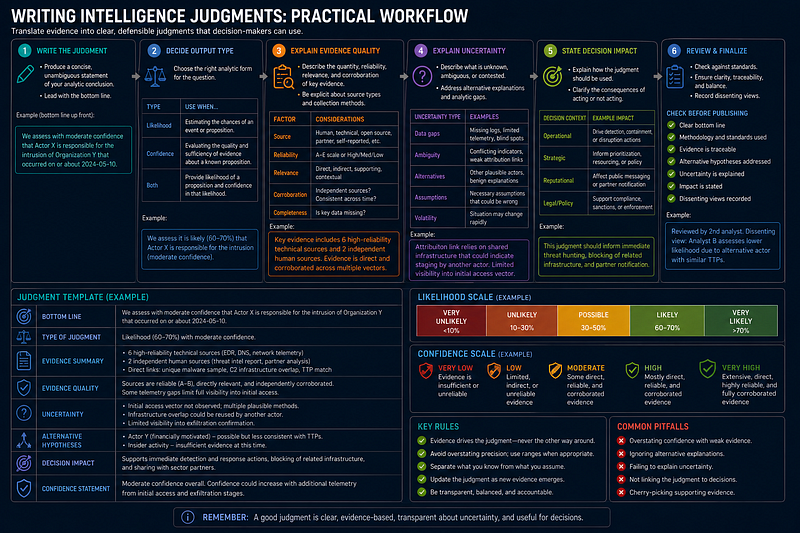
Example / Mini Case
A domain resolves to a shared hosting IP. Pivoting to every domain on that IP would create noise. A stronger pivot would require shared certificate attributes, unique URL paths, matching malware configuration, or close temporal overlap.
Analyst Checklist
- Is the seed source reliable?
- Is each pivot time-bounded?
- Are shared-hosting risks documented?
- Can the cluster be defended to a reviewer?
Output Artifact
Seed IOC:
Source:
Time Window:
Pivot Type:
Related Indicator:
Link Strength:
Reason Accepted / Rejected:
Cluster Boundary:
Limitations: