CTI Analyst Field Manual
Purpose
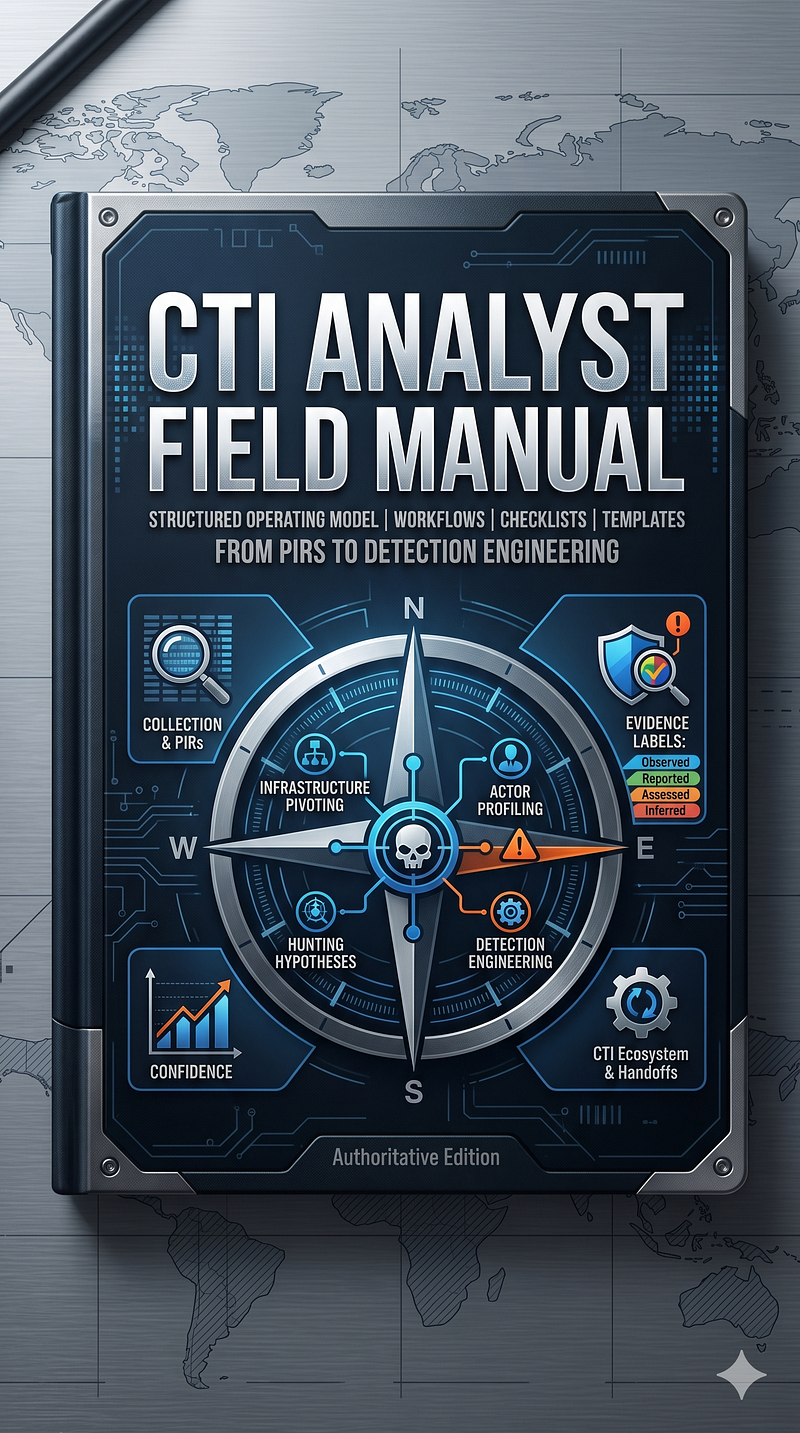
This manual provides a structured operating model for cyber threat intelligence work: from collection requirements to evidence handling, analytic judgment, infrastructure pivoting, actor profiling, hunting hypotheses, detection engineering, SOC handoff, and executive communication.
If you are reviewing the manual professionally, start with Role-Based Reading Paths, Publication-Grade Review Backlog, and Authoritative Bibliography.
CTI Ecosystem
This manual is one part of a three-book CTI ecosystem. Use CTI Project Ecosystem and Cross-Project Fact Correlation to move between general analyst tradecraft, customer delivery methodology, and the Israel-focused actor knowledge base.
- Customer-Driven AI CTI Project turns tradecraft into gated delivery.
- Israel Government Threat Actors CTI provides sector-specific actor, tool, TTP, hunt, and detection examples.
What This Manual Is
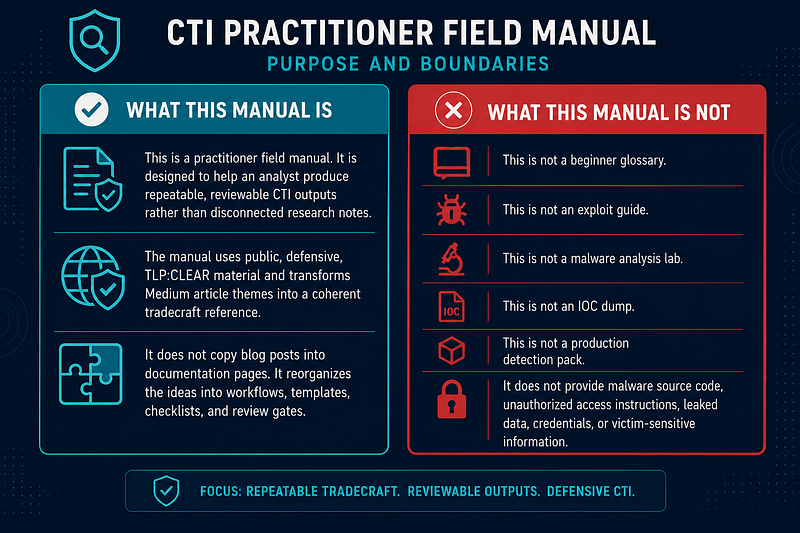
This is a practitioner field manual. It is designed to help an analyst produce repeatable, reviewable CTI outputs rather than disconnected research notes.
The manual uses public, defensive, TLP:CLEAR material and transforms Medium article themes into a coherent tradecraft reference. It does not copy blog posts into documentation pages. It reorganizes the ideas into workflows, templates, checklists, and review gates.
What This Manual Is Not
This is not a beginner glossary, an exploit guide, a malware analysis lab, an IOC dump, or a production detection pack. It does not provide malware source code, unauthorized access instructions, leaked data, credentials, or victim-sensitive information.
Operating Principles
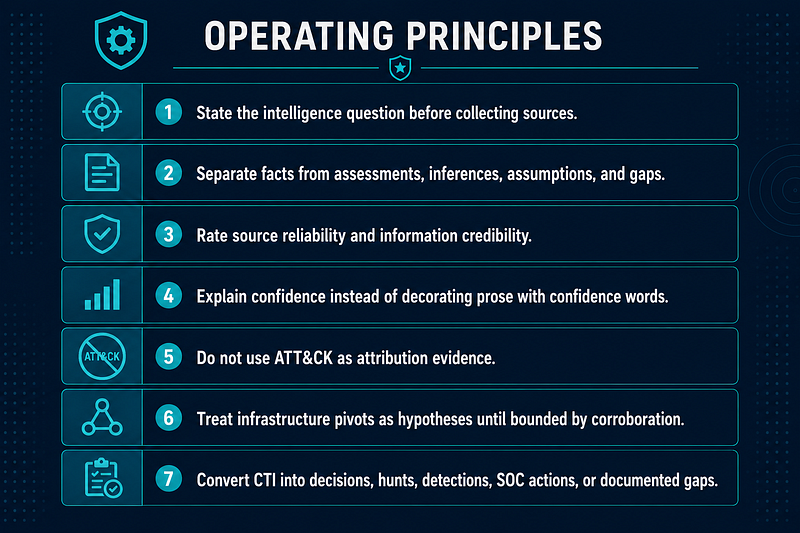
- State the intelligence question before collecting sources.
- Separate facts from assessments, inferences, assumptions, and gaps.
- Rate source reliability and information credibility.
- Explain confidence instead of decorating prose with confidence words.
- Do not use ATT&CK as attribution evidence.
- Treat infrastructure pivots as hypotheses until bounded by corroboration.
- Convert CTI into decisions, hunts, detections, SOC actions, or documented gaps.
Evidence Labels
The manual uses these labels:
- Observed: directly seen in telemetry, primary artifact, or controlled analysis.
- Reported: stated by a source.
- Assessed: analytic judgment by a source or by the analyst, with reasoning.
- Inferred: derived from indirect evidence; weaker than observed or reported.
- Unknown: not known from available evidence.
- Gap: required information is missing and should be collected or documented.
Confidence
Confidence reflects evidence quality, source access, corroboration, and analytic consistency. It does not equal probability. A high-confidence judgment can still be wrong if new evidence emerges; a low-confidence judgment may still be operationally important if impact is high.
How To Navigate
Start with CTI Foundations, then move into analytic discipline, frameworks, attribution, infrastructure pivoting, actor research, sector CTI, CTI-to-detection, AI-assisted CTI, and reusable templates.
Cross-Links
- What Is CTI
- PIR, SIR, and EEI
- Evidence Labels
- Attribution Methodology
- Intelligence to Detection
- Detection Readiness Levels
- AI CTI Control Matrix
References
- Authoritative Bibliography
- Medium source profile: medium.com/@1200km
- Public RSS source index: Medium Source Index