Evidence Labels
Purpose
Define a consistent evidence-labeling model so CTI claims can be reviewed, challenged, and converted into action without losing uncertainty.
Practitioner-Level Explanation
Evidence labels make analytic status explicit. They prevent analysts from writing every sentence as if it has the same evidentiary weight.
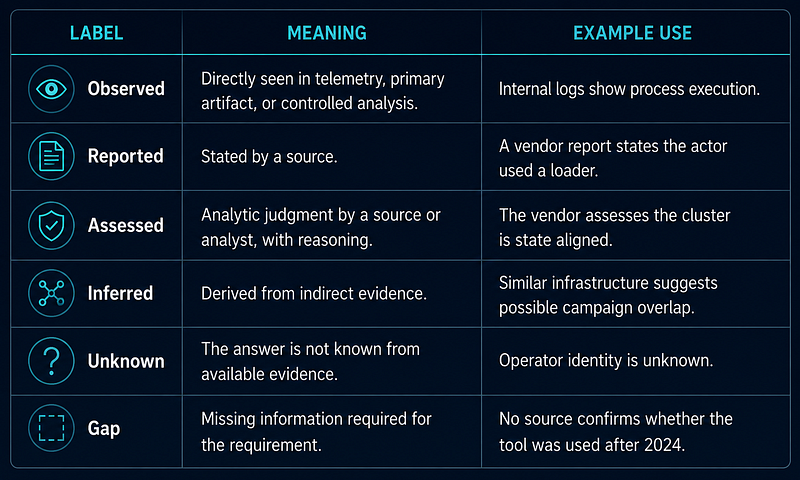
This manual uses six labels:
| Label | Meaning | Example Use |
|---|---|---|
| Observed | Directly seen in telemetry, primary artifact, or controlled analysis. | Internal logs show process execution. |
| Reported | Stated by a source. | A vendor report states the actor used a loader. |
| Assessed | Analytic judgment by a source or analyst, with reasoning. | The vendor assesses the cluster is state aligned. |
| Inferred | Derived from indirect evidence. | Similar infrastructure suggests possible campaign overlap. |
| Unknown | The answer is not known from available evidence. | Operator identity is unknown. |
| Gap | Missing information required for the requirement. | No source confirms whether the tool was used after 2024. |
Labels do not replace prose. The analyst still needs to explain source quality, confidence, contradictions, and limitations.
CTI Relevance
Evidence labels are useful across the whole CTI workflow:
- Source registers use them to classify extracted claims.
- Actor profiles use them to avoid overclaiming attribution.
- ATT&CK mappings use them to show whether behavior is observed or only actor-level reporting.
- Detection backlogs use them to decide whether a hypothesis is strong enough to test.
- Executive summaries use them to avoid false certainty.
Common Mistakes
- Treating reported claims as observed facts.
- Treating vendor assessments as universal truth.
- Using inferred links as attribution.
- Leaving gaps implicit.
- Failing to update labels when new evidence arrives.
Practical Workflow
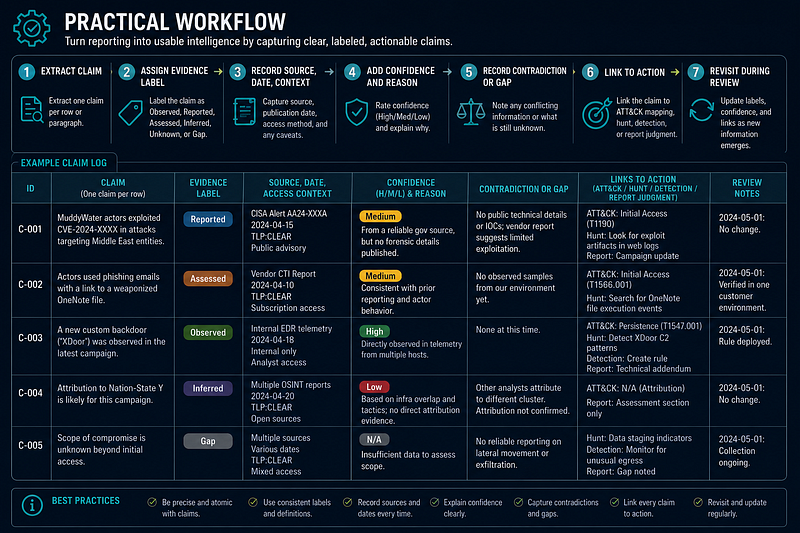
- Extract one claim per row or paragraph.
- Assign an evidence label.
- Record source, date, and access context.
- Add confidence and confidence reason.
- Record contradiction or gap.
- Link the claim to any ATT&CK mapping, hunt, detection, or report judgment.
- Revisit labels during review.
Example / Mini Case
Claim:
A public report states that a cluster used cloud storage to stage payloads.

Evidence Label:
Reported

Confidence:
Medium confidence, because the source is reliable but the report does not include telemetry excerpts or multiple corroborating sources.

Detection Use:
Do not alert on all cloud storage use. Build a hunt for cloud storage download followed by script execution on endpoints where that pattern is unusual.

Gap:
No internal telemetry has confirmed this behavior in the defended environment.
Analyst Checklist
- Is each major claim labeled?
- Are reported claims separated from observed facts?
- Are assessments attributed to the source or clearly marked as analyst assessment?
- Are inferred links prevented from becoming hard claims?
- Are gaps visible enough to drive follow-up collection?
- Are labels linked to downstream actions?
Output Artifact
Claim ID:
Claim:
Evidence Label:
Source:
Source Reliability:
Information Credibility:
Confidence:
Confidence Reason:
Contradiction / Gap:
Downstream Use:
Cross-Links
- Source Reliability
- Confidence Language
- Evidence Register Template
- ATT&CK Mapping Mistakes
- Attribution Methodology
- Israel CTI — Operating Standard (Claim Rules)
- Israel CTI — Fact Correlation (Shared Evidence Labels)
- Customer project — Artifact Contracts