ATT&CK Mapping Mistakes
Purpose
List common ATT&CK errors that reduce CTI and detection-engineering quality.
Practitioner-Level Explanation
ATT&CK can improve precision, but bad mappings create false confidence. The most common failure is mapping broad actor reporting to a technique and presenting it as local detection coverage.
Good mapping is narrow, evidence-backed, and operationally testable.
CTI Relevance
This page helps reviewers challenge weak mappings before they become dashboards, coverage claims, or detection backlogs.
Common Mistakes
- Mapping actor names instead of behavior.
- Mapping malware capability instead of observed use.
- Ignoring data sources and telemetry requirements.
- Overusing high-level techniques when sub-techniques exist.
- Treating ATT&CK as an attribution engine.
Practical Workflow
- Start with a source claim.
- Extract a behavior.
- Choose the narrowest defensible technique.
- Record tactic, procedure, evidence, and confidence.
- Add telemetry requirements.
- Assign mapping maturity.
- Reject mappings that cannot be supported.
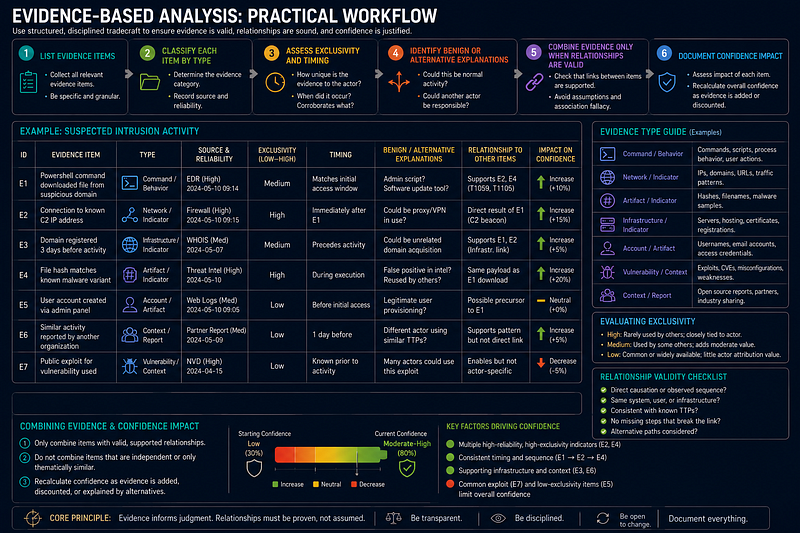
Example / Mini Case
A report says a tool can capture credentials. Do not map credential dumping unless the source reports observed credential dumping or analysis confirms capability and the page is explicit that the mapping is capability-based, not observed procedure.
Analyst Checklist
- Is this observed behavior or tool capability?
- Is the technique narrow enough?
- Is the mapping useful to a detection engineer?
- Is confidence justified?
- Would the mapping survive review?
Output Artifact
Mapping ID:
Claim:
Behavior:
Technique:
Tactic:
Evidence Label:
Observed / Capability / Actor-Level:
Telemetry:
Confidence:
Reviewer Notes: