Hunting Hypothesis Template
Purpose
Define a falsifiable hunt hypothesis format for CTI-driven threat hunting.
Practitioner-Level Explanation
A hunt hypothesis is a testable statement about adversary behavior in an environment. It should include behavior, telemetry, lookback window, expected malicious pattern, expected benign pattern, false positives, stop condition, and escalation path.
A hunt is not a keyword search. It is an investigation plan.
CTI Relevance
Hypotheses make CTI actionable without prematurely creating noisy alerts.
Common Mistakes
- Jumping from actor report to production alert.
- Skipping telemetry requirements.
- Ignoring false positives and tuning.
- Claiming coverage without validation.
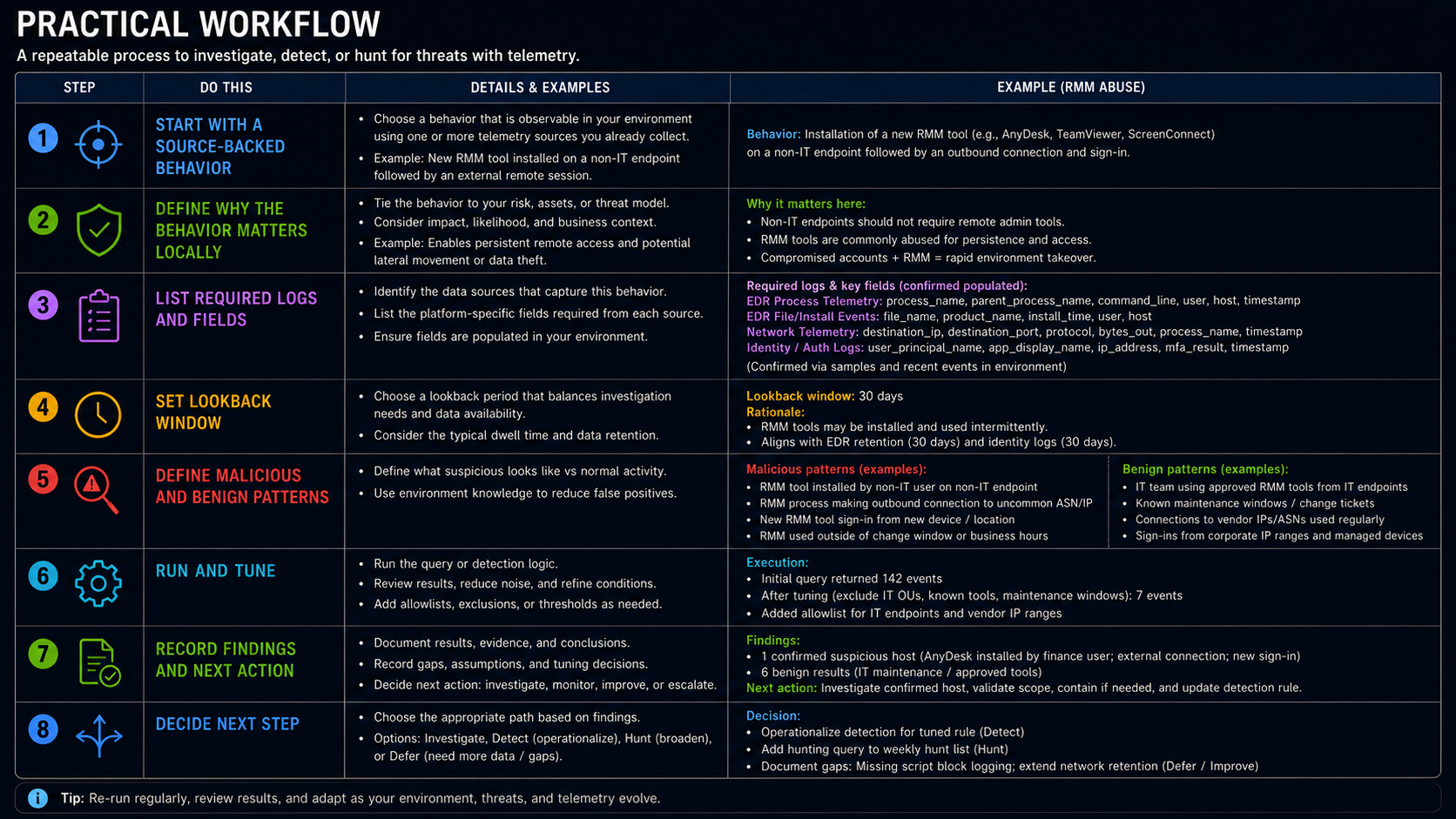
Practical Workflow
- Start with a source-backed behavior.
- Define why the behavior matters locally.
- List required logs and fields.
- Set lookback window.
- Define malicious and benign patterns.
- Run and tune.
- Record findings and next action.
Example / Mini Case
Hypothesis: If an actor abuses RMM tooling after phishing, then non-IT endpoints may show new RMM installation followed by remote session activity within 24 hours of suspicious email receipt.
Analyst Checklist
- Is there a source-backed behavior?
- Is telemetry available?
- Is the hypothesis testable?
- Are false positives named?
- Is readiness level honest?
Output Artifact
Hypothesis ID:
Source Claim:
Behavior:
Environment Relevance:
Telemetry:
Fields:
Lookback:
Expected Malicious Pattern:
Expected Benign Pattern:
False Positives:
Stop Condition:
Escalation: