Quick Reference Cheatsheet
19. Quick Reference Cheatsheet
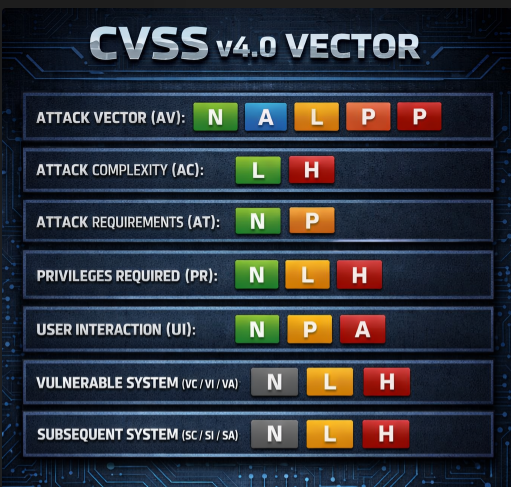
CVSS v4.0 Base Metrics — Complete Reference
ATTACK VECTOR (AV):
  N = Network     — Remotely exploitable from internet
  A = Adjacent    — Same network segment / LAN required
  L = Local       — Local interactive shell access required
  P = Physical    — Physical device access required

ATTACK COMPLEXITY (AC):
  L = Low   — Repeatable without special conditions; script it
  H = High  — Requires active bypass of security mechanisms (ASLR, race condition)

ATTACK REQUIREMENTS (AT):  [NEW in v4.0 — replaces part of old AC]
  N = None    — No special deployment configuration needed
  P = Present — Non-default config must be present in deployment

PRIVILEGES REQUIRED (PR):
  N = None  — Unauthenticated / pre-auth
  L = Low   — Regular user account
  H = High  — Administrator / root / privileged service account

USER INTERACTION (UI):
  N = None    — Attacker acts alone, no victim participation
  P = Passive — Victim views/receives something (opens page, email preview)
  A = Active  — Victim explicitly performs an action (clicks link, runs file)

VULNERABLE SYSTEM (VC/VI/VA):  [Replaces C/I/A in v3.x]
  N = None    H = High    L = Low

SUBSEQUENT SYSTEM (SC/SI/SA):  [Replaces Scope Changed in v3.x]
  N = None    H = High    L = Low
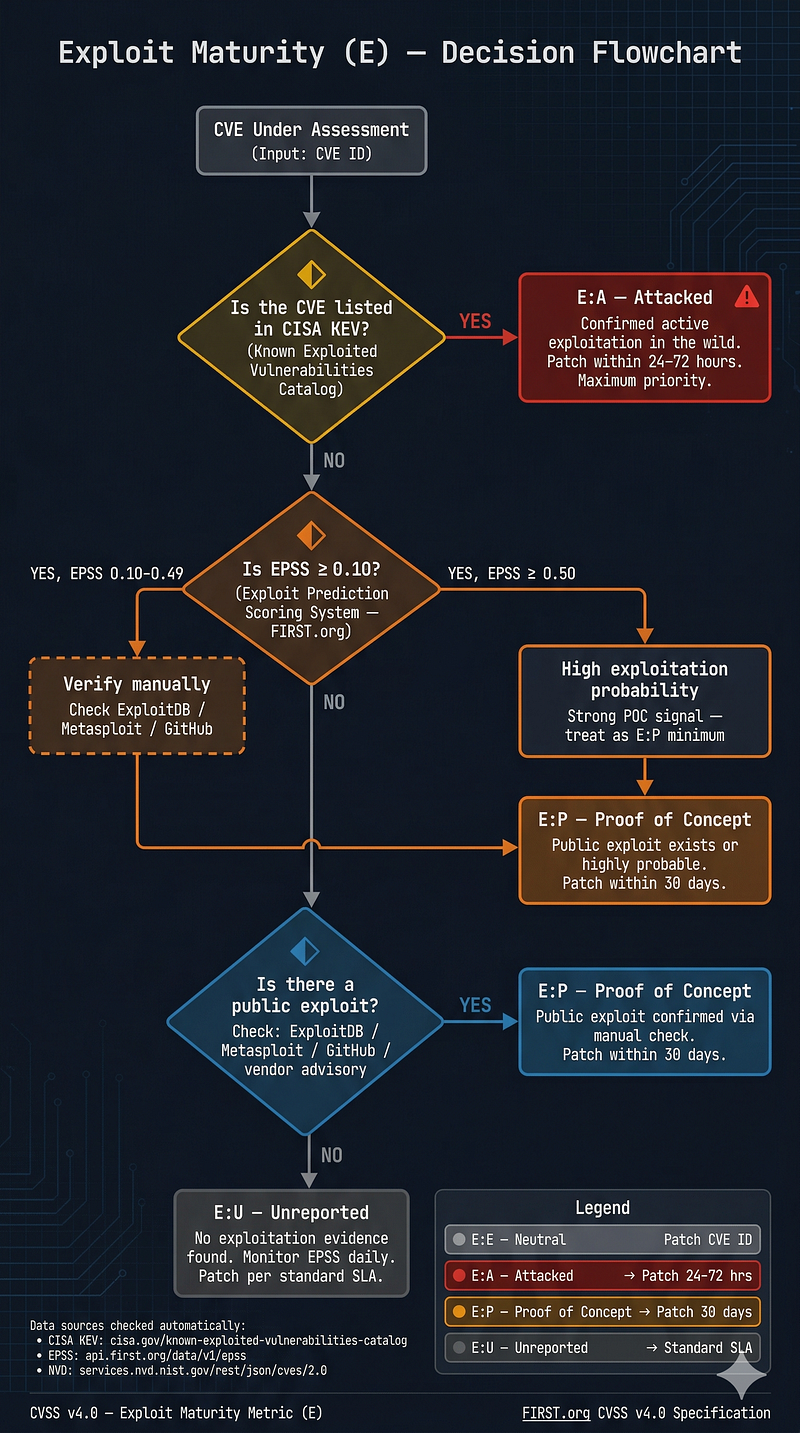
Exploit Maturity (E) — Decision Flowchart
Step 1 — Check CISA KEV:
  CVE in KEV catalog?
    YES →  E:A  (confirmed active exploitation)           → PATCH IMMEDIATELY
    NO  ↓

Step 2 — Check for exploit evidence (ExploitDB, Metasploit, GitHub, vendor advisory):
  Active exploitation or exploit toolkit confirmed? →  E:A
  Public proof-of-concept exists, no known attacks?  →  E:P
  No PoC, no reports, no exploit tooling found?      →  E:U

Step 3 — Use EPSS as a triage signal only:
  EPSS ≥ 0.1  →  ⚠ VERIFY flag — manually check ExploitDB / Metasploit / GitHub
                  If PoC found through that search → E:P (from Step 2, not from EPSS)
                  If active exploitation confirmed  → E:A (from Step 2, not from EPSS)
                  If nothing found → keep E:U
  EPSS < 0.1  →  E:U (no current exploitation evidence)

EPSS does NOT set E:P or E:A automatically.
EPSS is a probabilistic exploitation forecast, not proof of PoC availability.
E:P requires a confirmed public proof-of-concept.
E:A requires confirmed attacks in the wild or exploit tooling.
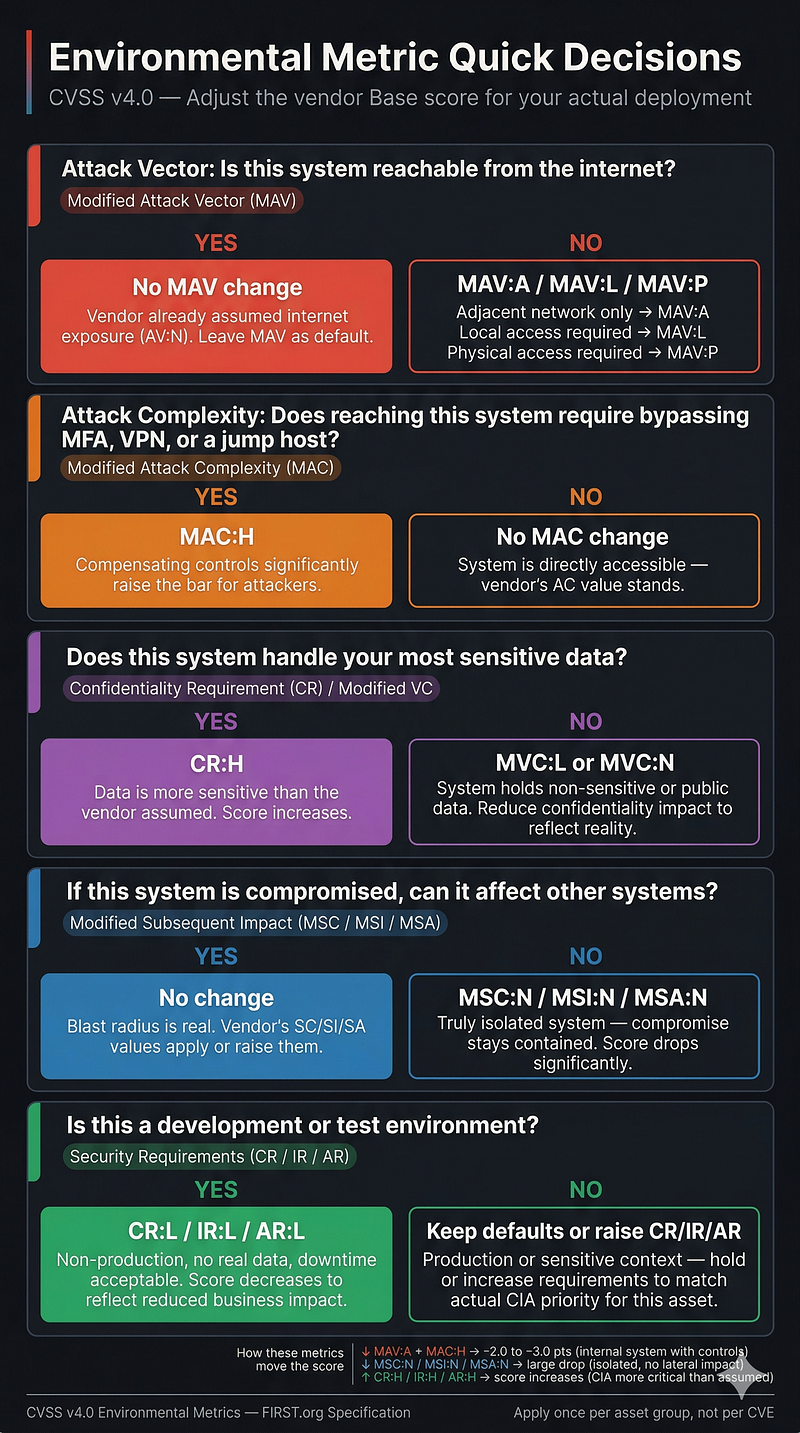
Environmental Metric Quick Decisions
"Is this system reachable from the internet?"
  YES → No AV change needed       NO → MAV:A (or L/P for more isolated)

"Does reaching this system require bypassing MFA/VPN/jump host?"
  YES → MAC:H                     NO → No AC change needed

"Does this system handle your most sensitive data?"
  NO → MVC:L (or N)              YES → No VC change, or set CR:H

"Can this system affect other systems if compromised?"
  NO → MSC:N/MSI:N/MSA:N        YES → No change, blast radius is real

"Is this a test/dev environment?"
  YES → CR:L/IR:L/AR:L           NO → Keep vendor defaults or raise CR/IR/AR
Score Impact Reference (Approximate)
| Adjustment | Typical Score Impact |
|---|---|
E:U (vs default E:X) | −2.5 to −3.5 points |
E:P (vs default E:X) | −1.0 to −1.5 points |
MAV:A (vs AV:N) | −1.5 to −2.5 points |
MAC:H (vs AC:L) | −0.5 to −1.5 points |
MSC:N/MSI:N/MSA:N (vs SC:H/SI:H/SA:H) | −1.0 to −2.0 points |
CR:H/IR:H/AR:H | +0.5 to +1.5 points |
CR:L/IR:L/AR:L | −0.5 to −1.0 points |
Note: CVSS v4.0 uses lookup tables, not formulas — these are empirical approximations.
Common Vector String Examples
# Worst case — all vendor defaults, no enrichment:
CVSS:4.0/AV:N/AC:L/AT:N/PR:N/UI:N/VC:H/VI:H/VA:H/SC:H/SI:H/SA:H
→ 10.0 Critical

# Internet-facing, actively exploited (CISA KEV):
CVSS:4.0/AV:N/AC:L/AT:N/PR:N/UI:N/VC:H/VI:H/VA:H/SC:H/SI:H/SA:H/E:A
→ 10.0 Critical (E:A maintains maximum — patch immediately)

# Internet-facing, POC exists, not yet actively exploited:
CVSS:4.0/AV:N/AC:L/AT:N/PR:N/UI:N/VC:H/VI:H/VA:H/SC:H/SI:H/SA:H/E:P
→ ~8.4 High (7-day SLA)

# Internal (adjacent network), POC exists, MFA VPN required:
CVSS:4.0/AV:N/AC:L/AT:N/PR:N/UI:N/VC:H/VI:H/VA:H/SC:H/SI:H/SA:H/E:P/MAV:A/MAC:H
→ ~7.4 High (30-day SLA)

# Internal, isolated (no subsequent system paths), no exploit evidence:
CVSS:4.0/AV:N/AC:L/AT:N/PR:N/UI:N/VC:H/VI:H/VA:H/SC:H/SI:H/SA:H/E:U/MAV:A/MAC:H/MSC:N/MSI:N/MSA:N
→ ~4.5 Medium (90-day SLA)

# OT sensor, adjacent network, non-sensitive data, no subsequent paths:
CVSS:4.0/AV:N/AC:L/AT:N/PR:N/UI:N/VC:H/VI:H/VA:H/SC:H/SI:H/SA:H/E:U/MAV:A/MAC:H/CR:L/MSC:N/MSI:N/MSA:N
→ ~3.9 Low (next maintenance window)
SLA Tiers by CVSS-BTE Score
| CVSS-BTE | Severity | Recommended SLA | Example Trigger |
|---|---|---|---|
| 9.0–10.0 | Critical | 24–72 hours | KEV entry, internet-facing, unauthenticated RCE |
| 7.0–8.9 | High | 30 days | POC + internet-facing, or KEV + internal |
| 4.0–6.9 | Medium | 90 days | Internal, compensating controls, limited exploit |
| 0.1–3.9 | Low | Next release | Air-gapped, CR/IR/AR:L, no exploit evidence |
| 0.0 | None | Informational | Patch when convenient |
Tools and Resources
SCORING & CALCULATION:
  FIRST.org v4.0 Calculator:   https://www.first.org/cvss/calculator/4-0
  NVD Calculator:              https://nvd.nist.gov/vuln-metrics/cvss/v4-calculator
  NVD API (vector retrieval):  https://services.nvd.nist.gov/rest/json/cves/2.0

SPECIFICATION & GUIDES:
  CVSS v4.0 Spec:              https://www.first.org/cvss/v4-0/
  Consumer Implementation Guide: https://www.first.org/cvss/v4.0/implementation-guide
  CVSS v4.0 User Guide:        https://www.first.org/cvss/user-guide

THREAT INTELLIGENCE:
  CISA KEV Catalog:            https://www.cisa.gov/known-exploited-vulnerabilities-catalog
  CISA KEV API (JSON):         https://www.cisa.gov/sites/default/files/feeds/known_exploited_vulnerabilities.json
  EPSS API:                    https://api.first.org/data/v1/epss?cve=CVE-XXXX-XXXXX
  ExploitDB:                   https://www.exploit-db.com
  Metasploit:                  msfconsole -q -x "search cve:XXXX-XXXXX"

COMPLEMENTARY FRAMEWORKS:
  SSVC (CISA):                 https://www.cisa.gov/sites/default/files/publications/cisa-ssvc-guide.pdf
  CVSS vs SSVC Decision Guide: https://www.first.org/cvss/v4.0/implementation-guide (Section 4)
Full Guide Navigation
| # | Chapter | Key Takeaway |
|---|---|---|
| 1 | Introduction | Base scores are worst-case estimates — not your answer |
| 2 | v3.1 vs v4.0 | Scope:Changed → SC/SI/SA; new AT metric; cleaner temporal |
| 3 | Vector String Anatomy | Every metric has a practical question — answer it honestly |
| 4 | Scoring Lifecycle | CVSS-B → CVSS-BT → CVSS-BTE — each layer adds precision |
| 5 | Threat & Environmental Metrics | KEV + EPSS + environmental profile = actionable score |
| 6 | Worked Examples | Log4Shell, Erlang/OTP, CitrixBleed, MOVEit — real CVE traces |
| 7 | Industry-Specific Scoring | Healthcare, Finance, OT — different CIA priorities |
| 8 | CVSS vs SSVC | SSVC for triage, CVSS for documentation and compliance |
| 9 | Practical VM Workflow | Scanner CSV → enriched ticket in 6 steps + Python script |
| 10 | Enrichment Tool | CLI that automates the full pipeline for any CVE list |
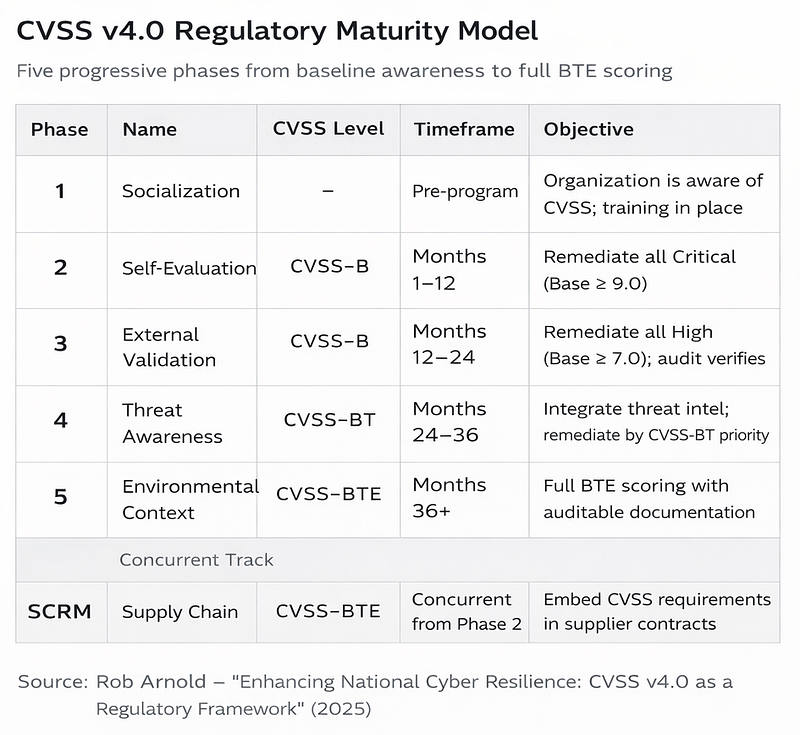
| 11 | Regulatory Evidence | 5-phase maturity model + audit evidence checklist |
| 12 | Mistakes & Interview Q&A | 8 errors to avoid + 6 interview questions |
| 13 | Cheatsheet | This page |
Conclusion
CVSS v4.0 answers the question that vulnerability managers have been asking for years: "Why is my scanner showing 500 Critical vulnerabilities when I clearly cannot patch all of them this week?"
The answer is not that CVSS is broken. The answer is that CVSS Base scores were never intended to be your final answer. They are the starting point — a common language between a vendor who does not know your environment and a security team that does.
The three-layer model (CVSS-B → CVSS-BT → CVSS-BTE) gives your team the tools to translate a generic score into a deployment-specific one. Threat metrics (E + EPSS) eliminate the false urgency from the 95% of CVEs with no known exploit. Environmental metrics eliminate the false priority from scoring isolated systems as if they were internet-facing.
The real-world examples in this guide — Log4Shell, CitrixBleed, MOVEit, Erlang/OTP, firmware reports — illustrate both directions of this system. Sometimes (Log4Shell, CitrixBleed) the 10.0 score is correct, and environmental arguments are irrelevant: you patch immediately because active exploitation is confirmed and your exposure is real. Sometimes (internal OT sensor, air-gapped development system) a 9.8 Base score correctly becomes a 3.9 Low, not because the vulnerability is less dangerous, but because your deployment makes exploitation genuinely difficult and downstream impact genuinely limited.
That is not gaming the system. That is using the system correctly.
Known Limitations of This Guide
| Area | Limitation |
|---|---|
| CVSS v4.0 vectors | Most worked-example vectors are analyst-computed using the FIRST.org calculator. NVD's CVSS v4.0 coverage is incomplete as of publication — many CVEs have only v3.1 NVD scores. Always verify vectors at FIRST.org calculator. |
| Enrichment tool scoring | The tool uses heuristic point-delta approximations, not the official CVSS v4.0 lookup tables. Results are prioritization guidance, not authoritative CVSS-BTE scores. |
| EPSS thresholds | EPSS values used for triage filtering are illustrative. EPSS is a triage signal; only actual exploit evidence (KEV, ExploitDB, Metasploit) should set E:P or E:A. |
| Score examples | Score approximations (e.g., "~7.4 High") are heuristic estimates. Exact scores depend on the full CVSS v4.0 calculation — verify with the official calculator. |
| KEV / EPSS data | KEV and EPSS data changes daily. All references to KEV status, EPSS scores, and attribution are accurate as of March 2026 and will drift over time. |
| Regulatory mapping | CVSS is a severity scoring tool, not a regulatory framework. Regulatory requirements (PCI DSS, HIPAA, NIS2, etc.) must be evaluated against the actual regulatory text, not this guide. |
| Not official FIRST.org documentation | This guide is an independent practitioner resource. Official CVSS v4.0 documentation: first.org/cvss/v4-0, User Guide, Implementation Guide. |
Author: Andrey Pautov Published: March 2026 Tags: CVSS, Vulnerability Management, CVSSv4, Security, CTI, Risk Management, EPSS, Log4Shell, CitrixBleed
References
- CVSS v4.0 Specification — FIRST.org: https://www.first.org/cvss/v4-0/
- CVSS v4.0 Consumer Implementation Guide — FIRST.org: https://www.first.org/cvss/v4.0/implementation-guide
- CVSS v4.0 User Guide — FIRST.org: https://www.first.org/cvss/user-guide
- EPSS (Exploit Prediction Scoring System) — FIRST.org: https://www.first.org/epss/
- CISA Known Exploited Vulnerabilities Catalog — CISA: https://www.cisa.gov/known-exploited-vulnerabilities-catalog
- SSVC (Stakeholder-Specific Vulnerability Categorization) — CISA: https://www.cisa.gov/ssvc
- NVD (National Vulnerability Database) — NIST: https://nvd.nist.gov
- NVD API 2.0 Documentation: https://nvd.nist.gov/developers/vulnerabilities
- CVE-2021-44228 (Log4Shell) — Apache: https://logging.apache.org/log4j/2.x/security.html
- CVE-2023-4966 (CitrixBleed) — Citrix: https://support.citrix.com/article/CTX579459
- CVE-2023-34362 (MOVEit SQLi) — Progress: https://www.progress.com/security
- CVE-2024-21762 (FortiOS) — Fortinet: https://www.fortiguard.com/psirt/FG-IR-24-015
- CVE-2025-32433 (Erlang/OTP SSH) — Erlang security advisories: https://www.erlang.org/security
- "CVSS: A Scoring System or a Tool?" — Oren Yulevitch, CVSS SIG presentation
- "Enhancing National Cyber Resilience: CVSS v4.0 as a Regulatory Framework" — Rob Arnold, Acorn Pass / CVSS Associates (2025)
- Joint Advisory: Apache Log4j Vulnerability — CISA, FBI, NSA (December 2021): https://www.cisa.gov/news-events/cybersecurity-advisories/aa21-356a
- CISA Advisory: Volt Typhoon (CVE-2024-21762 context): https://www.cisa.gov/news-events/cybersecurity-advisories/aa24-038a