CVSS v4.0 Enrichment Tool
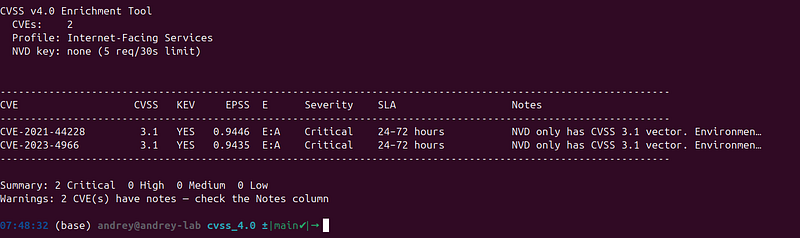
CVSS v4.0 Enrichment and Prioritization Tool
The enrichment tool uses empirical point-delta heuristics to approximate CVSS-BTE scores, not the official CVSS v4.0 scoring algorithm (which uses lookup tables, not formulas). Outputs should be treated as prioritization guidance, not authoritative CVSS-BTE scores. For authoritative scoring, use the FIRST.org CVSS v4.0 calculator with the vector strings the tool produces.
The pipeline described throughout this section is available as a standalone command-line tool: cvss_enrichment_tool (GitHub).
Installation
Requirements: Python 3.8+, requests library, internet access to NVD / CISA / FIRST.org APIs. No database, no additional dependencies.
# 1. Clone the repository
git clone https://github.com/anpa1200/cvss_4.0.git
cd cvss_4.0

# 2. Install the only dependency
pip3 install requests

# 3. Run a quick test (no API key needed)
python3 cvss_enrichment_tool.py --cves CVE-2021-44228 --profile internal_vlan
Optional — NVD API key. Without a key, NVD rate-limits requests to 5 per 30 seconds — sufficient for ad-hoc lookups. For batches larger than ~20 CVEs, register a free key at https://nvd.nist.gov/developers/request-an-api-key and pass it with --apikey:
python3 cvss_enrichment_tool.py \
  --file cves.txt \
  --profile internet_facing \
  --output report.csv \
  --apikey YOUR_KEY_HERE
How It Works
The tool implements the three-stage enrichment pipeline in a single automated run:
CVE IDs → NVD API (Base vector)
        → CISA KEV (E:A if listed)
        → EPSS API (⚠ VERIFY flag if ≥ 0.1 — not automatic E:P)
        → Manual PoC check for flagged CVEs → E:P / E:A if confirmed
        → Apply asset profile (MAV/MAC/CR/IR/AR/MSC...)
        → Output enriched vector + heuristic priority + SLA recommendation
Stage 1 — Base vector (NVD API 2.0). For each CVE ID the tool queries services.nvd.nist.gov and retrieves the CVSS vector string. It prefers a v4.0 vector; if only a v3.1 vector exists (common for CVEs predating November 2023), it applies threat-only enrichment and flags the result for manual re-scoring at the FIRST.org calculator.
Stage 2 — Threat enrichment (KEV + EPSS). The tool downloads the full CISA KEV catalog in a single request and checks each CVE against it. If listed → E:A (confirmed exploitation). For non-KEV CVEs, EPSS is used as a triage signal to flag CVEs for manual verification — it does not directly set E:P. See the output "Verify" column for CVEs that need exploit evidence review before assigning E:P.
Stage 3 — Environmental enrichment (asset profile). Modified Base metrics and Security Requirements from the selected profile are appended to the vector. The tool ships with six built-in profiles — internet_facing, internal_vlan, isolated_ot, dev_test, healthcare_ehr, pci_payment — covering the most common deployment contexts described in this article.
Output
The tool prints a severity-ranked table and optionally writes CSV (--output) or JSON (--json) for import into ticket systems or dashboards.
The table shows four distinct concepts — keep them separate:
- CVSS version: the version NVD provides (often still 3.1 for older CVEs)
- KEV / EPSS: threat intelligence inputs
- E: value: analyst-assigned exploit maturity
- Priority score / Severity / SLA: the heuristic-adjusted output for triage
Example — internet_facing profile (no environmental reduction applies):
CVE                   CVSS   KEV     EPSS  E      Priority    Severity    SLA
────────────────────────────────────────────────────────────────────────────────
CVE-2021-44228         3.1   YES   0.9446  E:A    ~10.0       Critical    24–72 hours
CVE-2023-4966          3.1   YES   0.9435  E:A    ~9.4        Critical    24–72 hours
CVE-2023-34362         3.1   YES   0.9437  E:A    ~9.8        Critical    24–72 hours
CVE-2024-21762         3.1   YES   0.9308  E:A    ~9.6        Critical    24–72 hours
CVE-2025-32433         3.1   YES   0.5031  E:A    ~9.6        Critical    24–72 hours
Example — same CVEs with internal_vlan profile (MAV:A + MAC:H applied):
CVE                   CVSS   KEV     EPSS  E      Priority    Severity    SLA
────────────────────────────────────────────────────────────────────────────────
CVE-2021-44228         3.1   YES   0.9446  E:A    ~7.4        High        30 days
CVE-2023-4966          3.1   YES   0.9435  E:A    ~7.0        High        30 days
CVE-2023-34362         3.1   YES   0.9437  E:A    ~7.2        High        30 days
CVE-2024-21762         3.1   YES   0.9308  E:A    ~7.3        High        30 days
CVE-2025-32433         3.1   YES   0.5031  E:A    ~6.5        Medium      90 days
The same CVE list — dramatically different priorities depending on your actual network zone. The internet_facing profile produces Criticals requiring immediate action; internal_vlan produces Highs and Mediums for your next maintenance window. Both sets of numbers are heuristic approximations — verify important findings against the FIRST.org calculator using the vector strings in the output.
Full documentation, profile definitions, and NVD API key instructions are in the repository README: https://github.com/anpa1200/cvss_4.0
Common Usage Patterns
Single CVE — quick check before a meeting:
python3 cvss_enrichment_tool.py \
  --cves CVE-2025-32433 \
  --profile internal_vlan

# Output (two columns — original severity vs profile-adjusted priority):
# CVE-2025-32433
#   NVD source vector:       CVSS v3.1 (v4.0 not yet available from NVD)
#   KEV:                     YES (added June 9, 2025) → E:A
#   EPSS:                    0.5031
#   Vendor severity (Base):  Critical [10.0 — NVD base, reachable-network worst-case]
#   Profile applied:         internal_vlan (MAV:A + MAC:H)
#   Adjusted priority:       ~6.5 Medium [heuristic — verify at FIRST.org calculator]
#   SLA recommendation:      90 days (patch at next maintenance window)
#   Enriched vector:         CVSS:4.0/AV:N/.../E:A/MAV:A/MAC:H
#
# NOTE: E:A (CISA KEV) is confirmed. Priority reduction is from environmental
# profile only (system is not internet-accessible). Do NOT defer indefinitely —
# if network posture changes, this becomes Critical again.
Batch from scanner — CSV input, JSON output for ticketing system:
# Export CVE list from Tenable / Qualys / Rapid7 → cves.txt (one per line)
python3 cvss_enrichment_tool.py \
  --file cves.txt \
  --profile internet_facing \
  --output enriched_report.csv \
  --json enriched_report.json \
  --apikey YOUR_NVD_KEY

# enriched_report.json is suitable for import into Jira, ServiceNow, or SIEM
Healthcare deployment — EHR system audit:
python3 cvss_enrichment_tool.py \
  --file ehr_cves.txt \
  --profile healthcare_ehr \
  --output ehr_report.csv

# healthcare_ehr profile sets CR:H / IR:H / AR:H by default
# Any CVE scoring ≥ 4.0 after enrichment gets flagged for HIPAA risk analysis
Comparing profiles for the same CVE list (what-if analysis):
for profile in internet_facing internal_vlan dev_test isolated_ot; do
  echo "=== Profile: $profile ==="
  python3 cvss_enrichment_tool.py \
    --file cves.txt \
    --profile $profile \
    --quiet  # summary only
done

# Shows how the same vulnerability list scores differently across your segments
# Critical finding: a 9.8 Critical in internet_facing may be 4.5 Medium in dev_test
Automation — daily cron enrichment:
#!/bin/bash
# /etc/cron.d/cvss-enrich — runs at 06:00 daily
DATE=$(date +%Y-%m-%d)
python3 /opt/cvss_4.0/cvss_enrichment_tool.py \
  --file /var/scanner/today_cves.txt \
  --profile internet_facing \
  --output /var/reports/enriched_${DATE}.csv \
  --json /var/reports/enriched_${DATE}.json \
  --apikey $NVD_API_KEY

# Post-process: alert on any new Critical findings
python3 /opt/cvss_4.0/alert_new_criticals.py /var/reports/enriched_${DATE}.json
Related Chapters
| Chapter | What you'll find |
|---|---|
| Practical VM Workflow | The manual version of this pipeline + ticket template |
| Threat & Environmental Metrics | How KEV, EPSS, and environmental profiles are determined |
| Scoring Lifecycle | The B→BT→BTE theory the tool implements |